Hormones
Histamine Intolerance and Hormones in Perimenopause
24 June 2026 · By Dr. B.J. Huber · 13 min read
There is a moment many women between their mid-thirties and fifty know, right in perimenopause: the glass of red wine that was part of life for decades suddenly brings a blocked nose and palpitations. The aged cheese sits heavy in the stomach. A stressful day ends with a headache and itchy skin. And no one can explain why the body suddenly reacts to things that were completely unproblematic before.
I am a natural scientist and researcher, and I am in this phase myself, so these changes affect me too. And I see a clear connection between two systems that are rarely explained together: histamine and hormones. In perimenopause in particular they interlock, and that explains the sudden increase in sensitivity better than all the lists of cut foods.
This article shows you the principle behind it, separates evidence from assumption, and shows what helps and what doesn’t.
- The bucket principle: Histamine is a messenger. Complaints only arise when the bucket overflows, when more histamine accumulates than the body can break down.
- The hormone link: Oestrogen activates the mast cells and drives histamine up, progesterone calms them again. In turn, histamine stimulates oestrogen production.
- Why now: Progesterone, which calms the mast cells, is the first to fall in perimenopause, often years before the last cycle.
- What’s still unclear: There are signs that oestrogen also lowers histamine breakdown via DAO, but this isn’t firmly proven in humans.
- What helps: Make sure the bucket doesn’t overflow: eat fresh rather than aged, support breakdown through nutrients, calm the gut, keep an eye on sleep, stress and blood sugar.
The bucket principle: it isn’t just one food’s fault
One thing first: histamine is not a bad thing. It is a messenger the body needs, made by everyone. It steers parts of the immune system, stimulates stomach acid, keeps you awake and acts on the blood vessels. Complaints do not arise from histamine itself, but from an imbalance: more histamine accumulates than the body can currently break down.1
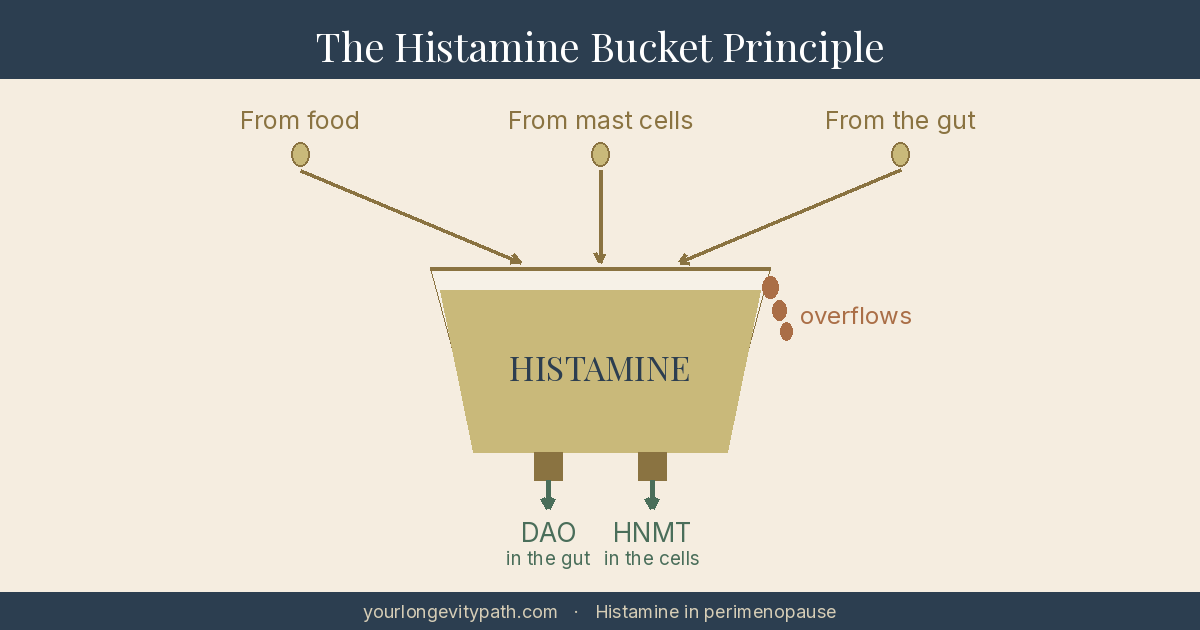
Picture a bucket. Histamine constantly drips in from the top, from several sources. At the bottom there is a drain, the breakdown. As long as the drain keeps up with the inflow, the bucket stays calm. When it overflows, the complaints come. That explains why the same glass of wine does nothing one day and, after little sleep and a lot of stress, hits immediately on another.
Where the histamine comes from: three sources
The inflow into the bucket has three sources. Most people think only of food, but two more come on top.
The first source is food. Histamine forms when bacteria convert the amino acid histidine in foods. This happens above all during ripening, fermentation and long storage. The more aged, fermented or older a food, the more histamine: aged cheese, salami, red wine, sauerkraut, anything stored for a long time.1
The second source is the body itself. Histamine is stored in the mast cells, which sit where the body has contact with the outside world: in skin, airways and gut. They release, among other things, histamine on demand, for example during an allergy, stress, heat or injury.
The third source is the gut itself. Certain gut bacteria produce histamine. When the gut flora falls out of balance, the histamine level can rise. In affected people there is indeed an altered gut flora and a more permeable gut barrier.6 More on this in the article on gut and perimenopause.
The breakdown: two enzymes, DAO and HNMT
Facing the inflow is the breakdown, and for it the body has two routes. One is handled by the enzyme DAO (diamine oxidase). It breaks down mainly the histamine from food, right in the gut, before it reaches the bloodstream. The other is handled by the enzyme HNMT (histamine-N-methyltransferase). It works inside the cells and breaks down the histamine that has already arrived there, above all in tissues such as the brain and airways.1
In histamine intolerance, DAO is at the centre because it catches the dietary histamine in the gut. When DAO works well, the bucket stays calm. When DAO activity isn’t enough, the body cannot keep up with the breakdown.1 In affected people, a lowered DAO activity can indeed be measured in the blood.9
What weakens the drain: a damaged gut lining, certain medications, alcohol, and a lack of the nutrients DAO needs to work. Alcohol is doubly unfavourable here, it supplies histamine itself and slows DAO at the same time. That is exactly why the blocked nose after a glass of red wine is one of the most typical everyday signals. In some women there is an inherited component on top: in one study, around 79 per cent of people with histamine intolerance symptoms carried at least one gene variant that lowers DAO activity.8
The hormone link: oestrogen drives, progesterone calms
Histamine and the female hormones are closely linked. This connection is missing from most explanations, yet it makes the difference in midlife.
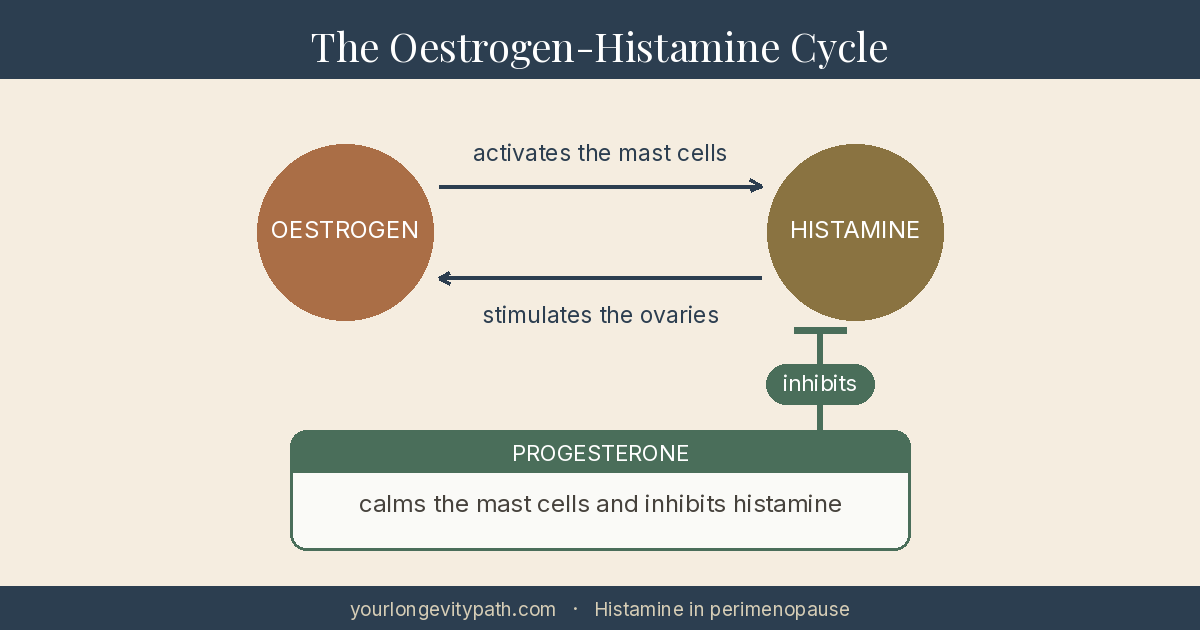
Oestrogen drives histamine up. Mast cells carry binding sites for oestrogen, and oestradiol, the strongest form, activates them directly. Via a membrane receptor it triggers a calcium influx. This prompts the mast cells to release and amplifies their reaction to other stimuli.2 More oestrogen therefore tends to mean more histamine.
And it works both ways. In turn, histamine stimulates the ovaries to produce more oestrogen. In experiments on human ovarian cells, histamine increased oestradiol release in a dose-dependent way, mediated via the H1 receptor.4 This creates a self-reinforcing loop: more oestrogen makes more histamine and vice versa.
Progesterone works against it. It calms the mast cells, so they release less histamine.3 As long as there is enough progesterone, it keeps oestrogen and histamine in check.
One limitation belongs here, so I don’t claim more than the evidence allows. There are signs that oestrogen additionally lowers histamine breakdown via DAO. But this isn’t firmly proven in humans: the evidence comes from a few, partly old animal studies. One study in healthy women even found that DAO activity is higher in the second half of the cycle, precisely when, alongside oestrogen, progesterone is also high.5 That fits better with progesterone supporting the breakdown. What stays well supported are the two clear points: oestrogen activates the mast cells, progesterone calms them. The rest I would read as a plausible but not yet proven assumption.
Why perimenopause makes everything worse
Oestrogen drives histamine up, progesterone calms it. Then it’s clear what happens in perimenopause.
Progesterone falls first. As early as the mid to late thirties, long before the last cycle, progesterone declines, while oestrogen is still high and above all fluctuating strongly. Many women therefore live for years with relatively little progesterone before they notice the first typical complaints. Exactly what otherwise calms the mast cells is now missing, just when the body would need it most. How this drop in progesterone connects to sleep and restlessness, I describe in the article on exhaustion and burnout in perimenopause.
Oestrogen fluctuates unpredictably. In perimenopause oestrogen no longer rises and falls evenly, but strongly and irregularly. The body swings between too much and too little, without finding balance. The histamine swings become more noticeable as a result.
The gut probably plays a part. Some gut bacteria can reactivate excreted oestrogen, so part of it re-enters the circulation, the so-called estrobolome. In theory this could raise the histamine level further. But whether these bacteria actually steer oestrogen levels in humans is not proven. I place this in context in the article on gut and perimenopause.
Many women recognise the pattern from younger years, by the way: more headaches or skin reactions just before the period, when oestrogen is high and progesterone is low. Exactly this constellation becomes the permanent state in perimenopause. Heat is also among the triggers, because it irritates mast cells further, which is why hot flushes and a warm summer can worsen the topic.
Symptoms of histamine intolerance: why they vary so much
Because histamine acts in so many systems at once, the complaints are widely scattered, and that is exactly what makes the topic so hard to grasp.1 Many of those affected have a long search behind them, often told it is probably just stress.
Typical symptoms, sorted by area:
- Gut: bloating, fullness, abdominal pain, diarrhoea
- Head: headaches and migraine
- Skin: flushing, itching, hives
- Airways: runny or blocked nose
- Heart and mind: palpitations, inner restlessness, sleep problems
Not every woman has all of them. The telltale sign is the pattern of several seemingly unrelated complaints that only fit together once you recognise histamine as the cause.
Allergy, histamine intolerance or MCAS?
It is worth keeping three conditions apart. Histamine plays a role in all three, but the mechanism behind each is a different one. This explains why some people react only to food and others to almost everything.
An allergy is a classic, usually IgE-mediated immune reaction to an actually harmless allergen. There is a clear trigger, and the immune system reacts to it.
Histamine intolerance (HIT) is by contrast a breakdown problem: too little DAO. The triggers are mainly food and alcohol, the complaints usually single symptoms, and much can be influenced through diet.1
Mast cell activation syndrome (MCAS) is a release problem: over-sensitive mast cells that release histamine from many triggers, from stress, heat, hormones or infections. The complaints affect several systems and often come in flares. MCAS belongs in medical hands, this is not a matter for self-diagnosis. Mixed forms are possible.
What really helps
The goal is for the bucket not to overflow. There are three ways to get there, which work best together: let less histamine drip in, strengthen the breakdown, and calm the body’s own sources, above all the mast cells and the gut. One important sentence first: a strict low-histamine diet is a phase for observing, not a permanent state.
Fresh is better than aged. This is the simplest and most effective rule. The fresher a food, the less histamine. Often it is not the foods themselves that are the problem, but leftovers, long-stored and reheated items. Eat freshly cooked meat right away or freeze it immediately. Some foods are not high in histamine themselves but stimulate its release, often citrus fruits, tomatoes, spinach and strawberries. That explains seemingly contradictory reactions to “healthy” foods.
Eat low-histamine, but only for a while. In an acute phase, for example with badly irritated skin, low-histamine eating makes sense. As soon as things calm down, high-quality histamine-containing foods should be reintroduced slowly. Whoever avoids very strictly over the long term challenges the breakdown enzymes less and loses the practised handling of histamine. So the rule is: test carefully and raise the amount slowly, instead of cutting foods forever.
Support the breakdown. For DAO to work, it needs certain nutrients: the enzyme is copper-dependent and works together with vitamin B6 and vitamin C; zinc and manganese also play a part.1 The balance of zinc and copper matters, because years of high, uncontrolled zinc intake can lower copper and help trigger histamine problems. Which values make sense in this phase at all is in the article on blood tests in perimenopause.
Calm the mast cells. Several substances are considered mast-cell-stabilising, above all quercetin and vitamin C. Others such as reishi, omega-3, curcumin or black seed oil are often named in practice but are more thinly supported.
Calm the gut. Because a large part of the problem sits in the gut, gut health is central. An intact lining produces more DAO, a balanced gut flora produces less histamine. A first small pilot study indicates that a histamine-conscious diet can push back histamine-forming gut bacteria.7
Sleep, stress and blood sugar. These three levers are underestimated. Stress activates the mast cells directly, so breaks, breathing and a calm daily structure act on histamine too. Histamine keeps you awake, which is why poor sleep raises the histamine level, and calm evenings with fixed sleep times relieve doubly. And stable blood sugar means less stress for the body, which is why a look at insulin resistance and blood sugar in perimenopause helps keep the histamine level lower.
The first step: a small diary
One important note for you: before you cut foods, look closely for two to three weeks. Note what goes on the plate and how you feel afterwards, and pay particular attention to the connection with meals, sleep, stress and the cycle phase. This lets you recognise connections. Even small changes can noticeably lower the histamine level.
You don’t have to find the one guilty food. You have to make sure that no more histamine builds up than your body can break down. There are several starting points for that.
In coaching we look at exactly this: where your histamine comes from, what disrupts the breakdown in your case, and which steps make sense for you, instead of a blanket list of bans.
Birgit
If you would like to find out what makes the biggest difference for you, my coaching for perimenopause offers the right framework, or you can start with a free initial consultation.
Scientific Sources
- Maintz L, Novak N. Histamine and histamine intolerance. Am J Clin Nutr. 2007;85(5):1185–1196. doi:10.1093/ajcn/85.5.1185 · PMID:17490952
- Zaitsu M, Narita S, Lambert KC, et al. Estradiol activates mast cells via a non-genomic estrogen receptor-α and calcium influx. Mol Immunol. 2007;44(8):1977–1985. doi:10.1016/j.molimm.2006.09.030 · PMID:17084457
- Vasiadi M, Kempuraj D, Boucher W, Kalogeromitros D, Theoharides TC. Progesterone inhibits mast cell secretion. Int J Immunopathol Pharmacol. 2006;19(4):787–794. doi:10.1177/039463200601900408 · PMID:17166400
- Bódis J, Tinneberg HR, Schwarz H, et al. The effect of histamine on progesterone and estradiol secretion of human granulosa cells in serum-free culture. Gynecol Endocrinol. 1993;7(4):235–239. doi:10.3109/09513599309152507 · PMID:8147230
- Ono S, et al. Effect of the menstrual cycle on serum diamine oxidase levels in healthy women. Clin Biochem. 2012;45(16–17):1508–1511. PMID:23099198
- Schink M, Konturek PC, Tietz E, et al. Microbial patterns in patients with histamine intolerance. J Physiol Pharmacol. 2018;69(4). doi:10.26402/jpp.2018.4.09 · PMID:30552302
- Sánchez-Pérez S, Comas-Basté O, Duelo A, et al. The dietary treatment of histamine intolerance reduces the abundance of some histamine-secreting bacteria of the gut microbiota in histamine intolerant women. A pilot study. Front Nutr. 2022;9:1018463. doi:10.3389/fnut.2022.1018463 · PMC9633985
- Latorre-Moratalla ML, et al. Pilot study on the prevalence of diamine oxidase gene variants in patients with symptoms of histamine intolerance. Nutrients. 2024;16(8):1142. doi:10.3390/nu16081142 · PMID:38674832
- Manzotti G, Breda D, Di Gioacchino M, Burastero SE. Serum diamine oxidase activity in patients with histamine intolerance. Int J Immunopathol Pharmacol. 2016;29(1):105–111. doi:10.1177/0394632015617170 · PMID:26574488
What are the symptoms of histamine intolerance?
Because histamine acts in many systems at once, the complaints are widely scattered: in the gut bloating and fullness, headaches and migraine, skin flushing and itching, a blocked or runny nose, plus palpitations, inner restlessness and sleep problems (Maintz and Novak, 2007). The telltale pattern is several seemingly unrelated complaints at the same time.
Why can I suddenly no longer tolerate red wine or cheese in perimenopause?
Because what otherwise calms the histamine is missing. Progesterone stabilises the mast cells and supports histamine breakdown, and it is the first to fall in perimenopause (Vasiadi et al., 2006). At the same time, oestrogen activates the mast cells so they release more histamine (Zaitsu et al., 2007). Red wine and aged cheese are especially high in histamine, and alcohol also slows the breakdown. What was no problem before now makes the bucket overflow.
What does oestrogen have to do with histamine?
Oestrogen and histamine reinforce each other. Oestrogen activates the mast cells that store and release histamine (Zaitsu et al., 2007). In turn, histamine stimulates oestrogen production in cell studies (Bódis et al., 1993). This creates a loop. Progesterone works against it and calms the mast cells (Vasiadi et al., 2006).
Is histamine intolerance the same as an allergy?
No. An allergy is an immune reaction to a specific allergen, usually via IgE. With histamine intolerance, by contrast, the breakdown capacity is lacking, mainly the enzyme DAO in the gut, so histamine accumulates (Maintz and Novak, 2007). To be distinguished from this is mast cell activation syndrome (MCAS), in which over-sensitive mast cells release histamine from many triggers. MCAS belongs in medical hands.
How can I break down histamine better?
The enzyme DAO is copper-dependent and works together with vitamin B6 and vitamin C; zinc and manganese also play a part (Maintz and Novak, 2007). Balance matters: years of high, uncontrolled zinc intake can lower copper and help trigger histamine problems. An intact gut lining helps too, because it produces more DAO. A strict low-histamine diet is a phase for observing, not a permanent state.
This article is for informational purposes only and does not replace professional medical advice, diagnosis, or treatment. If you have health concerns, please consult a qualified healthcare professional.