Hormone
Is the science ruining your gut in perimenopause?
22 May 2026 · By Dr. B.J. Huber · 11 min read
You are in perimenopause, struggling with bloating, exhaustion and brain fog, and you are looking for answers. So you google, or you ask an AI. And the answer sounds the same everywhere you look: eat at least 30 different plants a week for your gut flora, take plenty of fermented foods, and whatever you do, do not forget sulforaphane from broccoli sprouts to detoxify your oestrogen.
On paper this sounds excellent. For a healthy gut, it is. But many women in perimenopause experience the opposite of improvement after this advice: bloating like the sixth month of pregnancy, more brain fog, skin reactions and leaden fatigue. They seem to be doing everything right and feel worse.
This rarely means the advice is fundamentally wrong. It means the advice comes from studies and databases that reflect an average, not the particular situation of a body whose hormones are in flux. This is exactly where it pays to look behind the recommendation rather than follow it blindly.
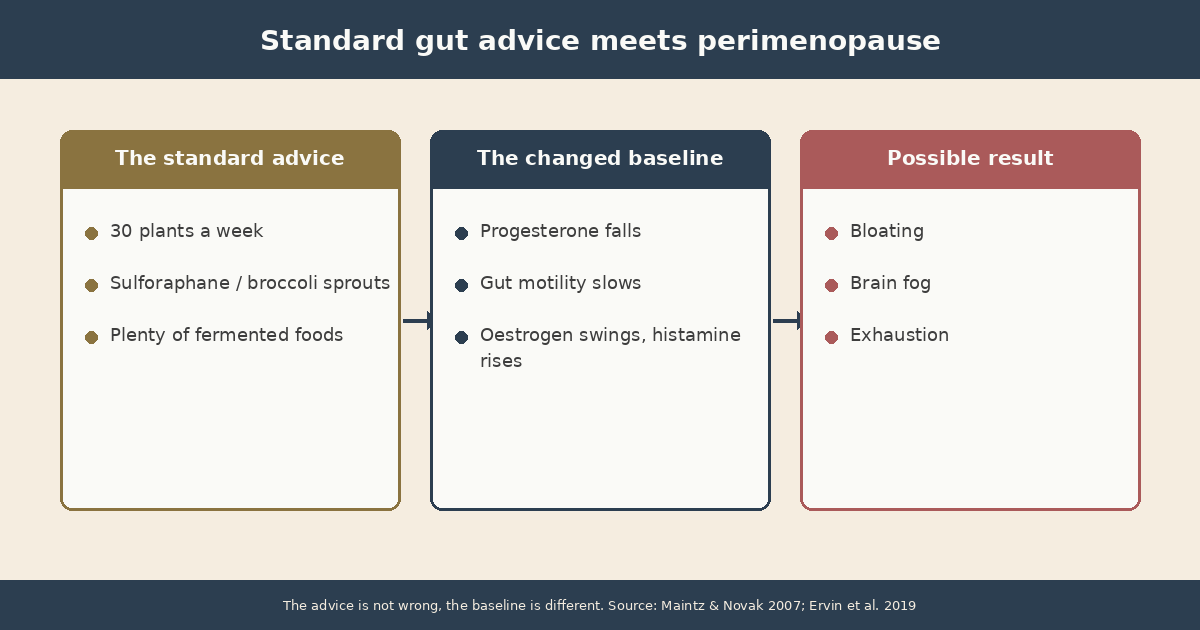
- Standard gut advice comes from studies in mostly healthy populations. In perimenopause the baseline changes: the drop in progesterone slows gut motility, which can encourage small intestinal bacterial overgrowth (SIBO).
- Fluctuating oestrogen stimulates mast cells and lowers DAO, the histamine-clearing enzyme. Fermented foods as a histamine source can then worsen symptoms (Maintz & Novak, 2007).
- The estrobolome modulates oestrogen via the enzyme beta-glucuronidase (Ervin et al., 2019). But the liver processes oestrogen first, and the simplified “fix the gut” advice falls short.
- Gentle and tolerable beats aggressive: well-studied, low-bloating fibres such as PHGG, liver support and a calmer nervous system.
Why do studies and AI almost always give the same gut advice?
Because they reflect an average. Large microbiome studies mostly examine mixed, largely healthy populations, and an AI summarises exactly this majority data. The hormonal special case of perimenopause falls through the cracks.
The 30-plant recommendation, for instance, comes from large observational data such as the American Gut Project, which showed that more plant diversity is statistically linked to more bacterial diversity. That is a valuable finding, but it is a statement about population averages, not a treatment plan for an individual body in a particular phase.
In perimenopause the baseline changes measurably. A 2022 study documented that the gut microbiome shifts markedly across the menopause transition, with consequences for metabolism and hormones (Peters et al., 2022). Advice that holds for a stable, healthy gut can meet this changed ground and act differently than intended.
This does not mean the research is wrong. It means general recommendations need to be matched to your own situation rather than copied one to one.
Why can the 30-plant rule backfire in perimenopause?
Because in perimenopause gut motility often slows. Progesterone relaxes smooth muscle and supports onward transport through the gut. When it falls, transit can slow, and a sudden sharp increase in fibre meets a gut that handles it less well.
A central mechanism is the migrating motor complex, a wave-like cleaning movement that clears bacteria and debris from the small intestine between meals. This movement is co-regulated by sex hormones. If it slows, bacteria can linger longer in the small intestine and multiply there. That is the ground on which small intestinal bacterial overgrowth (SIBO) can develop, which brings bloating, fullness and irregular digestion.
If large amounts of fermentable fibre from many different plants are now added, it is not only the desired bacteria in the colon that get fed, but also a possible overgrowth in the small intestine. The fibres ferment more strongly, more gas forms, and the abdomen distends. This explains why some women paradoxically feel worse after switching to a very plant-heavy diet.
Importantly, plant diversity is not a bad thing. The point is the pace and the amount. A gut that is currently more sensitive benefits more from a gradual increase than from an abrupt jump to 30 varieties.
What does the liver have to do with your oestrogen-gut cycle?
A great deal, and this step is exactly what most estrobolome tips leave out. The liver is the first and most important organ for processing hormones. It packages oestrogen into an excretable form before it ever reaches the gut. So the gut only works with what the liver supplies.
The estrobolome, the part of the gut bacteria that modulates oestrogen, is real and well described. These bacteria produce the enzyme beta-glucuronidase, which can reactivate already “packaged” oestrogen in the gut and send it back into circulation (Ervin et al., 2019). From this came the popular advice: clean up your gut and the hormone problems will resolve.
Here a closer look pays off. The research shows a more complex picture than the simple formula suggests. Across the menopause transition, bacterial diversity tends to decline, and with it beta-glucuronidase activity changes too, often towards less rather than more (Frontiers in Endocrinology, 2025). The blanket narrative of “too much beta-glucuronidase, so detox the gut” therefore does not apply to every woman. Some have the opposite pattern.
In practice this means: anyone who focuses only on the gut and works it with aggressive measures often misses the real lever. If the liver is overloaded by chronic stress, poor sleep, alcohol or nutrient deficiency, it cannot process oestrogen cleanly, and no gut protocol in the world makes up for that. Gently relieving the liver is often more useful than flooding the gut. For how closely gut and hormones are linked, see our detailed article here.
Why do many women suddenly stop tolerating fermented foods?
Because oestrogen and histamine are closely linked. Oestrogen prompts mast cells to release histamine, and at the same time it lowers the activity of DAO, the enzyme that breaks histamine down in the gut. In perimenopause, when oestrogen fluctuates erratically, this balance is easily thrown off.
On top of this, progesterone normally stabilises mast cells. Since progesterone often falls first in perimenopause, a dual burden arises: more histamine is released and at the same time less is broken down (Maintz & Novak, 2007). This can show up as bloating, palpitations, headaches, skin flushing or inner restlessness, often without the woman noticing the link to her diet.
Fermented foods such as sauerkraut, kombucha, aged cheese or yoghurt are naturally histamine-rich. The very thing recommended as a gut booster can worsen symptoms in a histamine-sensitive woman. This is not an argument against fermented foods as such, but a cue to take your own reaction seriously.
A simple pointer: if symptoms regularly increase after histamine-rich meals, or worsen in the second half of your cycle, it is worth looking at histamine more closely with medical guidance.
What about sulforaphane and sulfur-rich foods?
Sulforaphane from broccoli sprouts is often marketed as a miracle for oestrogen detoxification. It can stimulate the body’s own detox enzymes, and for many people it is well tolerated. But for a sensitive digestive system the same rule applies: observe first, then increase.
Sulforaphane and other cruciferous foods such as broccoli, cabbage or garlic are rich in sulfur compounds. In some people with disturbed gut flora or limited sulfur processing, certain gut bacteria can produce more hydrogen sulfide from them, a foul-smelling gas that can worsen bloating. The research on this individual sensitivity is still young, and it is not a rule for everyone but a possible explanation when someone reacts noticeably to sulfur-rich food.
The practical point stays the same as with fibre: a food that performs well in studies need not suit every body in every phase. If you are regularly bloated and tired after broccoli sprouts or a lot of garlic, that is a signal, not a failure of your discipline.
What actually helps, gently and tolerably?
If aggressive protocols can worsen symptoms, the opposite path is worth taking: gentle measures that relieve the liver, calm the gut and are usually well tolerated even with histamine or sulfur sensitivity. The following are possible building blocks, not a protocol, and belong with medical guidance if symptoms are present.
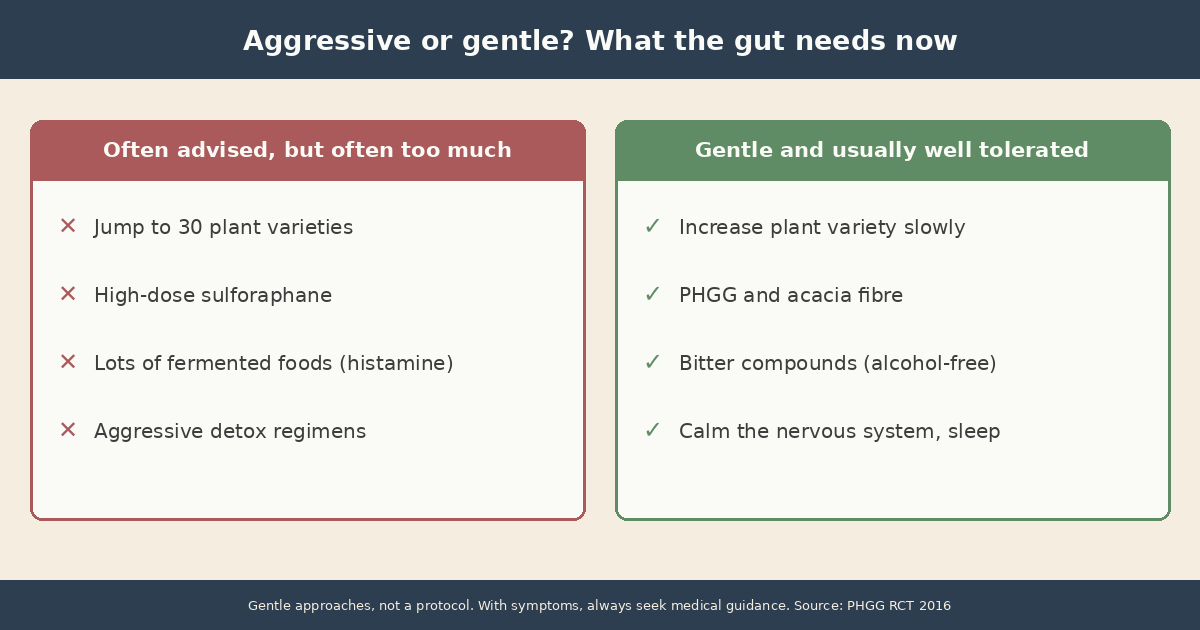
1. Support the liver gently rather than detoxing aggressively. Bitter compounds, for example from artichoke or dandelion, can stimulate bile flow. Bile is the transport that carries processed oestrogen from the liver into the gut. With histamine sensitivity, alcohol-free versions are suitable. Basics like enough sleep, less alcohol and stress regulation also noticeably relieve the liver.
2. Gentle fibre instead of a fibre shock. Rather than abruptly jumping to 30 plant varieties, particularly well-tolerated fibres help. Partially hydrolysed guar gum (PHGG) is well studied: in a randomised controlled trial it significantly improved bloating in irritable bowel syndrome and is considered low-bloating and low-FODMAP suitable (PHGG RCT, 2016). Acacia fibre is another mild option. Both feed the good bacteria gently rather than overloading the gut.
3. Keep an eye on sulfur and histamine load. Certain micronutrients act as cofactors here: molybdenum is a building block of the enzyme that breaks down sulfur compounds, and vitamin B6 (as P-5-P) is a cofactor for histamine-clearing DAO. This is basic biochemistry, not a cure. Whether targeted supplementation makes sense belongs on the basis of blood markers and medical advice, not guesswork.
4. Calm the nervous system. The gut does not digest in constant alarm. In perimenopause cortisol is often elevated, and chronic stress throttles digestive secretions and irritates mast cells further. Slow exhalation, short breaks and time in nature are not wellness decoration; they measurably lower the stress response and create the precondition for the gut to settle.
How do you find out what works for you?
By making yourself your most important data source. No study average and no AI knows your individual reaction. A simple symptom diary over two to three weeks, noting meals, digestion, energy and mood, often shows more clearly than any online tip what suits you and what does not.
A few guiding questions help with interpretation:
- Do bloating or fatigue regularly worsen after certain foods (fermented, sulfur-rich, very high-fibre)?
- Do symptoms cluster in the second half of your cycle, when progesterone falls?
- Has your tolerance changed only in recent years, alongside other signs of perimenopause?
If a pattern emerges, that is the starting point for targeted steps rather than more protocols. And if symptoms are stubborn, a medical assessment belongs in the picture, for example for SIBO or a histamine problem.
What to take away
The general research is not wrong about the importance of the microbiome and the estrobolome. But the solutions often derived from it, and passed on by AI and mainstream media, are sometimes too crude for women in perimenopause. What is true for a stable gut can act differently on a body in hormonal transition.
The most important stance is therefore not a new, stricter protocol, but a closer look: look behind the advice, take your own reaction seriously, go gently rather than aggressively. If a tip considered healthy gives you bloating, a racing heart or exhaustion, it is not the right one for you in this moment.
If you want to make sense of the bigger picture across hormones, gut, liver and nutrition, without fighting through contradictory online tips, you can book a free initial consultation. We will look together at which steps make sense in your situation, always within what coaching can do and what belongs in medical hands.
If you want to work on your gut in a structured way, my gut health coaching provides the framework for it.
Scientific sources
-
Ervin, S. M., et al. (2019). Gut microbial β-glucuronidases reactivate estrogens as components of the estrobolome. Journal of Biological Chemistry, 294(49), 18586–18599. doi: 10.1074/jbc.RA119.010950
-
Gut microbiota has the potential to improve health of menopausal women by regulating estrogen. (2025). Frontiers in Endocrinology. doi: 10.3389/fendo.2025.1562332
-
Peters, B. A., et al. (2022). Menopause Is Associated with an Altered Gut Microbiome and Estrobolome, with Implications for Adverse Cardiometabolic Risk. mSystems. doi: 10.1128/msystems.00273-22
-
Maintz, L., & Novak, N. (2007). Histamine and histamine intolerance. The American Journal of Clinical Nutrition, 85(5), 1185–1196. doi: 10.1093/ajcn/85.5.1185
-
Diet, the Gut Microbiome, and Estrogen Physiology: A Review in Menopausal Health and Interventions. (2026). Nutrients, 18(7), 1052. doi: 10.3390/nu18071052
-
Partially hydrolyzed guar gum (PHGG) versus placebo in the treatment of patients with irritable bowel syndrome: A randomised clinical study. (2016). PMC4744437
Are 30 plants a week harmful in perimenopause?
Not in principle. Plant diversity is sensible for a healthy gut. In perimenopause, however, a sudden sharp increase in fibre can worsen symptoms if small intestinal bacterial overgrowth (SIBO) or a sensitive digestion is already present. Individual tolerance is what matters.
Why can't I tolerate fermented foods anymore?
In perimenopause oestrogen fluctuates strongly, and oestrogen stimulates mast cells to release histamine while lowering DAO, the enzyme that breaks histamine down. Fermented foods are histamine-rich and can then trigger symptoms such as bloating, palpitations or skin reactions.
Should I fix my estrobolome in perimenopause?
The estrobolome (the oestrogen-modulating gut bacteria) is real and relevant, but the simple formula "fix the gut, solve the hormones" falls short. The liver processes oestrogen first, and the gut only works with what the liver supplies. A gentle, whole-picture approach with medical guidance makes more sense.
This article is for informational purposes only and does not replace professional medical advice, diagnosis, or treatment. If you have health concerns, please consult a qualified healthcare professional.