Foundations
Longevity, Anti-Aging, Biohacking — What Actually Matters?
10 January 2026 · By Dr. B.J. Huber · 4 min read
Longevity, anti-aging, biohacking — three terms, one confusion
These terms are often used as if they mean the same thing, but they point in very different directions. If you care about healthy aging, the distinction matters. It shapes the questions you ask, the guidance you follow, and whether your actions address the real issue.
- Longevity targets healthspan (years of vitality and independence), not just lifespan — and focuses on the 12 measurable Hallmarks of Aging that determine aging speed (López-Otín et al., 2023).
- Anti-aging addresses cosmetic symptoms; biohacking optimizes isolated metrics — but both miss the systemic biology unless connected to the core mechanisms of cellular aging.
- Aging is not fixed: the 12 Hallmarks (genomic instability, telomere shortening, mitochondrial dysfunction, epigenetic changes, and others) are modifiable through lifestyle, nutrition, and targeted interventions.
Longevity: Not simply living longer, but living healthier longer
Modern longevity research is not mainly about adding years at any cost. Its focus is healthspan: the years you live with energy, resilience, clarity, and as much independence as possible.
That shift matters. The real goal is not just more time, but better years.
Anti-aging: The outer appearance focus
Anti-aging is most strongly associated with cosmetics and dermatology. It concentrates on visible signs of aging such as wrinkles, skin elasticity, or hair changes. That does not necessarily address the biology underneath.
Supporting the body well from the inside can absolutely influence what you see on the outside. But that visible effect is a consequence, not the core purpose.
Biohacking: Self-experimentation with tools and data
Biohacking often means using data, technology, and personal experiments to improve performance or health. It can be helpful. The challenge is that individual interventions are sometimes treated in isolation, without considering the wider biochemical context.
What research actually shows
A common scientific framework is the Hallmarks of Aging (a reference tool that was recently expanded in 2023 from 9 to 12 biochemical mechanisms in the prestigious journal Cell). It highlights that aging processes can be precisely measured at the cellular level and modulated through lifestyle, nutrition, movement, recovery, and environmental factors.
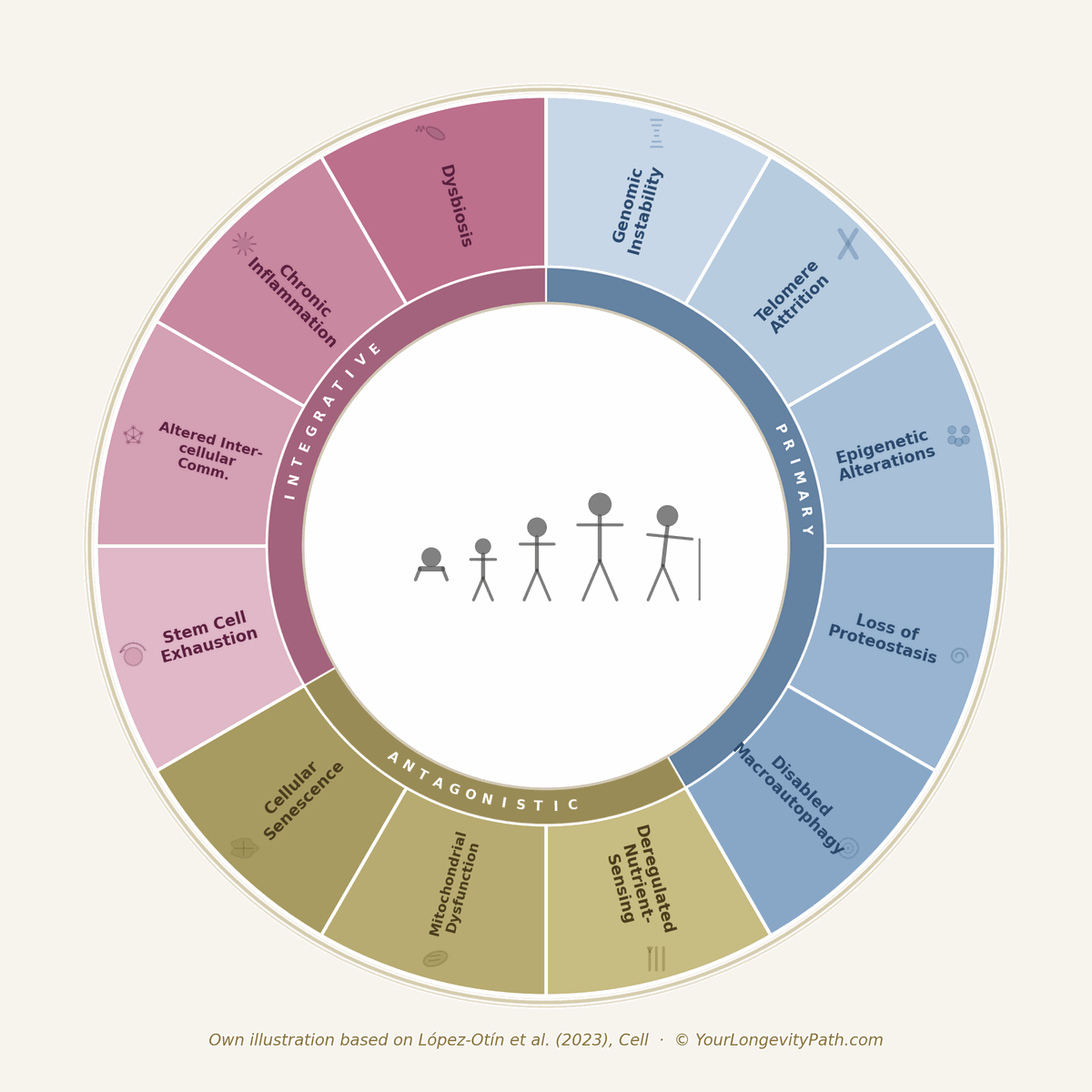
These 12 hallmarks fall into three categories: Primary hallmarks such as genomic instability or telomere attrition cause the underlying cellular damage. Antagonistic hallmarks like mitochondrial dysfunction or cellular senescence are the body’s responses to that damage. And integrative hallmarks such as chronic inflammation or dysbiosis describe the systemic consequences when repair mechanisms can no longer keep up.
The key takeaway is encouraging: aging is not a fixed program. There are measurable factors you can influence, and many of them are surprisingly practical.
What does that mean in real life?
Longevity is not one supplement, one gadget, or one extreme protocol. It is a personalized, evidence-based approach that starts where your body currently needs support the most.
That is also how I work: understand what may be going on, interpret meaningful biomarkers, and turn that into a plan that works in real life. And if you’re wondering how to actually implement these changes without overwhelming yourself, the strategy of changing one habit at a time is where most people find their entry point.
My understanding of longevity
For me, longevity means translating research into decisions that make sense in everyday life. Not as a rigid formula, but as an individual path toward a longer, healthier healthspan.
What this looks like once it meets your values and your daily life is what my longevity coaching is for. A free initial consultation is the easiest way to start.
Scientific Sources
- López-Otín, C., Blasco, M. A., Partridge, L., Serrano, M., & Kroemer, G. (2023). Hallmarks of aging: An expanding universe. Cell, 186(2), 243-278. doi: 10.1016/j.cell.2022.11.001
Dr. B.J. Huber is a PhD scientist and Longevity and Functional Health Coach, combining scientific depth with practical application.
What's the difference between longevity and anti-aging?
Anti-aging fights surface symptoms of aging. Longevity targets the biological root causes — the 12 Hallmarks of Aging — and aims for more healthy years, not just more years.
What are the 12 Hallmarks of Aging?
Twelve measurable cellular mechanisms that drive aging, including telomere shortening, mitochondrial dysfunction, epigenetic changes, and chronic inflammation.
At what age should you start focusing on longevity?
Biological aging begins in your mid-20s. The earlier you start, the greater the effect. But even at 40, 50, or 60, measurable improvements are still achievable.
This article is for informational purposes only and does not replace professional medical advice, diagnosis, or treatment. If you have health concerns, please consult a qualified healthcare professional.