
Free guide · Instant PDF
Exhausted, even though your results come back "normal"? The 10 hormone values that really matter during menopause.
Download now
Your compact hormone guide, free PDF.
Enter your email and the guide arrives in your inbox within the next 1 to 2 minutes.
No spam. No data sold. One email per week, unsubscribe whenever you like.
Disclaimer: This guide is for educational purposes and does not replace medical advice, diagnosis or treatment.
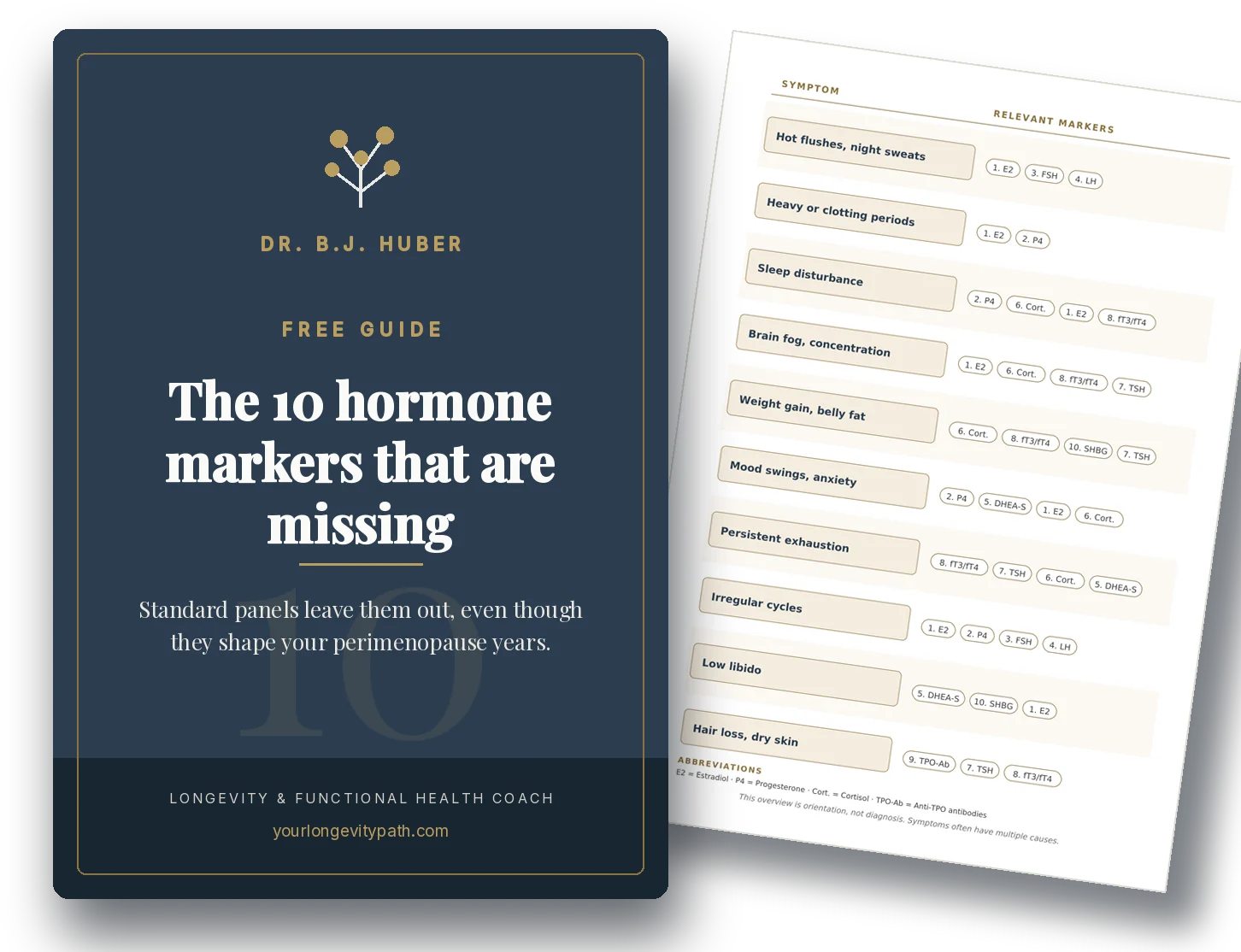
Your report says “TSH normal, FSH normal”, and yet you don't feel like yourself. The guide explains ten hormone values for the menopause transition: what each one shows, how reliable it is and which symptoms it may relate to.
- The 10 markers in 4 areas: sex hormones, stress and the adrenal glands, thyroid, metabolism (SHBG)
- Symptom map: which markers are worth a look for hot flushes, poor sleep, exhaustion, mood changes or an irregular cycle
- Lab ranges and coaching reference points, clearly separated: typical lab ranges, plus reference points from my coaching for some markers, labelled as experience-based
- Do you need lab tests at all? From 45, menopause is diagnosed without a hormone test. The guide shows where blood tests are still useful.
- Printable list for your blood test: with the right timing for each marker, for your GP, your gynaecologist or an independent lab
- 35 sources: studies and guidelines, with a note on how well each marker is supported

Dr. Birgit J. Huber
PhD scientist and researcher. Functional Health Coach with a focus on hormones, gut health, energy and ADHD.
19
Pages
10
Hormone markers explained
35
Sources cited
Why this guide
Everything is within the normal range, and yet you don't feel like yourself.
You wake up at night. During the day you are tired, your mood swings, and your mind works more slowly than it used to. Then the lab report says: TSH normal, FSH normal, everything within range.
A value within the reference range means it lies where most healthy people's values lie. It does not tell you whether it fits your symptoms. On top of that, the thyroid, stress hormones and metabolism also change during these years. Many lab reports do not include them at all.
From the age of 45, doctors diagnose the menopause transition from your cycle and symptoms. A hormone test is not needed for this, as the European specialist societies recommend. Blood tests are still useful: they help you make sense of your symptoms, show changes over time and help a doctor check for thyroid disease, iron deficiency or metabolic problems.
The guide covers ten markers. For each one you'll learn what it shows, how reliable it is and what you can do yourself. Where there are only experience-based values from my coaching, I say so.
It doesn't replace a medical diagnosis. It helps you have a focused conversation with your doctor about your results.
Frequently asked questions
- How much does the guide cost?
- Nothing. You get the full 19-page PDF guide free and immediately in your email inbox.
- Who is this guide for?
- For women in their late 30s to mid-50s who can feel something is changing (sleep, energy, mood, weight, cycle), and still don't get answers from standard testing.
- Will I get lots of marketing emails afterwards?
- You'll receive my weekly Longevity newsletter with grounded context, new studies and practical pointers. You can unsubscribe in one click, I don't sell your data.
- Is this a medical diagnosis?
- No. The guide is an educational resource. It does not replace medical advice, diagnosis or treatment. For health concerns, please consult a qualified healthcare professional.
- How is this different from the general bloodwork guide?
- The bloodwork guide explains 10 markers for inflammation, blood sugar, heart and blood vessels, vitamins, minerals and the thyroid, for women and men. This guide focuses on the menopause transition: estradiol, progesterone, FSH and LH, DHEA-S and the daily cortisol profile, TSH, free T3 and T4, TPO antibodies and SHBG. Ferritin, vitamin D and blood sugar are covered in the bloodwork guide.
Not ready yet?
Read up first.
If you're not sure the guide is right for you, take a look at the most-read articles on menopause.
Exhaustion
Exhaustion or Burnout? Why Women Over 40 Get the Wrong Diagnosis
Perimenopause and burnout reinforce each other. Which lab values bring real clarity.
Read article →Lab tests
The Perimenopause Blood Tests Your Doctor Probably Isn't Running
FSH and estradiol aren't enough. The biomarkers that actually matter: fasting insulin, ApoB, hsCRP, ferritin, free T3.
Read article →Brain fog
Brain Fog, Fatigue, Gut Issues: Why Perimenopause Starts in Your Gut
Brain fog during perimenopause has three root causes: estrobolome disruption, neuroinflammation, gut-brain axis breakdown.
Read article →Coaching
Hormone coaching for perimenopause
When you want your hormone profile placed in context systematically. Online from Switzerland for English-speaking clients.
To the hormone coaching page →Disclaimer: This guide and the coaching do not replace medical diagnosis, treatment or therapy. Dr. Birgit J. Huber is a PhD scientist, not a physician. For health concerns, please consult a qualified healthcare professional.