Supplements
7.5 Years Cognitively Younger — With One Mineral
2 April 2026 · By Dr. B.J. Huber · 11 min read
Are you doing everything right for your stress, sleeping enough, exercising, maybe even meditating, but your brain still feels wired and exhausted? You’re not alone. And the answer might lie in a mineral most people overlook, or rather, in a specific form of that mineral that most supplements fail to deliver where it matters most: your brain.
Magnesium is the gatekeeper of neuroplasticity, stress resilience, and cognitive aging. The problem is that most supplements barely move the needle on brain levels. They stay in your gut and bloodstream. This is where magnesium L-threonate (often patented as Magtein®) changes the picture entirely.
Unlike other forms, this compound is the only one clinically proven to significantly elevate cerebral magnesium levels. Every form of the mineral crosses the blood-brain barrier to some degree (your brain would die without it), but standard supplements like citrate or glycinate fail to raise concentrations in a therapeutically meaningful way. L-threonate does. And that distinction matters enormously for stress, sleep, and long-term brain health.
- L-threonate is a vitamin C metabolite that serves as a specific carrier across the blood-brain barrier — the only oral form proven to meaningfully raise cerebral magnesium (Slutsky et al., 2010).
- Magnesium blocks NMDA receptors and downregulates the HPA axis, breaking the stress-magnesium depletion cycle that amplifies anxiety, sleep disruption, and cognitive decline.
- A recent RCT showed cognitive age reduction of 7.5 years, increased parasympathetic tone (higher HRV), and improved subjective sleep quality after just 6 weeks at 2g daily (Lopresti et al., 2026).
Why Your Brain Needs Magnesium
Magnesium serves two critical roles in the brain. First, it acts as a natural NMDA receptor antagonist, blocking excess glutamate signaling. This prevents excitotoxicity, the process where too much neural firing damages neurons and triggers inflammation. Second, magnesium is essential for synaptic plasticity: the ability of your brain to form new connections and consolidate memories.
When levels drop, both systems falter. Your neurons become hypersensitive to stress signals. Your brain struggles to transition from “on alert” to “at rest.” Over time, this creates a vicious cycle: stress depletes the mineral, deficiency amplifies the stress response, and your nervous system gets stuck in overdrive.
Research shows that even mild deficiency increases transcription of CRH (corticotropin-releasing hormone) in your hypothalamus, the command center of your stress response (Sartori et al., 2012). This leads to elevated ACTH and cortisol, which in turn further depletes the nutrient from tissues. The cycle accelerates aging.
In short: magnesium deficiency in the brain fuels chronic stress, and L-threonate is uniquely equipped to break that cycle.
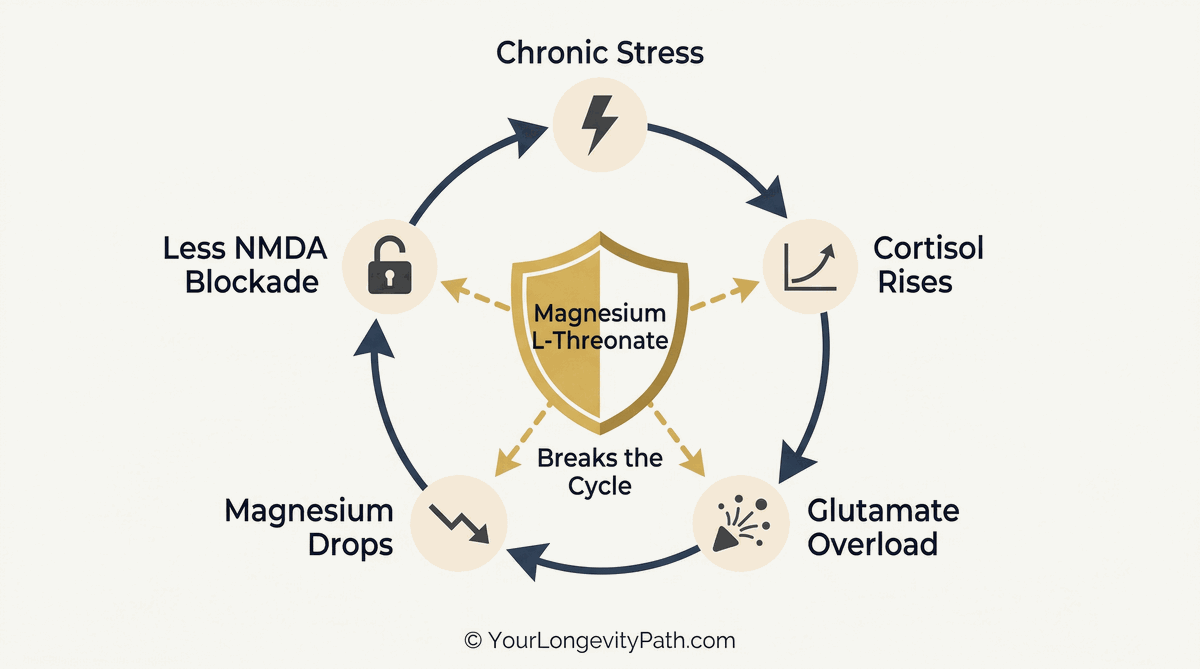 Fig. 1: The stress-magnesium vicious cycle: Chronic stress depletes magnesium levels, weakening NMDA blockade and further amplifying the stress response. Magnesium L-threonate can break this cycle (Pickering et al., 2020; Sartori et al., 2012). © YourLongevityPath.com
The L-Threonate Advantage: A Molecular Workaround
So why not just take more of it? The obstacle is physics. Regular supplements (citrate, glycinate, malate) improve systemic health, but they fail to meaningfully raise cerebral concentrations. The blood-brain barrier simply doesn’t let enough through.
L-threonate is a metabolite of vitamin C (ascorbic acid). It has no biochemical connection to the amino acid L-threonine, despite the similar name. L-threonate acts as a highly specific carrier molecule. It uses specific transport pathways (including vitamin C transporters) to effectively carry magnesium across cell membranes directly into the central nervous system. This is not passive diffusion; it is an active, carrier-mediated process.
Sun et al. (2016) demonstrated that L-threonate modulates intracellular magnesium concentration and increases synaptic density. In other words: the carrier molecule itself is biologically active, which partly explains why magnesium L-threonate (Magtein®) has such a pronounced effect on brain function.
What the Research Shows
Learning, Memory, and Synaptic Strength
The foundational study comes from Slutsky et al. (2010), who showed that magnesium L-threonate increases brain magnesium by approximately 15% in the cerebrospinal fluid of rodents. That may sound modest, but it is a neurobiological breakthrough: no other oral magnesium form achieves comparable cerebral increases. This elevation correlated with enhanced learning speed, improved working memory, and increased synaptic density in the hippocampus, the brain’s memory hub. The mechanism: higher brain magnesium strengthens NMDA receptor signaling, which is essential for long-term potentiation (LTP), the cellular basis of learning.
Human Evidence: Cognition, Sleep, and Cognitive Age
A recent randomized, double-blind, placebo-controlled trial (Lopresti et al., 2026) tested Magtein® in 100 healthy adults aged 18 to 45 over 6 weeks at 2g per day. Results included:
- Faster reaction time and hand-eye coordination: Participants showed measurable improvements in tasks requiring fine motor control and cognitive speed.
- Reduced cognitive age by 7.5 years: After just 6 weeks of supplementation, participants’ brains functioned measurably younger. For a supplement, this is an extraordinary longevity outcome.
- Improved subjective sleep: Sleep-related impairment scores (PROMIS Sleep Disturbance) improved significantly. An important note on transparency: objective sleep parameters measured by the Oura Ring (sleep duration, sleep stages) did not change significantly. What improved was subjective sleep experience and sleep-related daytime functioning.
- Enhanced parasympathetic tone: Resting heart rate decreased and heart rate variability (HRV) increased during sleep, indicating a shift toward the calm, regenerative “rest-and-digest” state.
That last point matters for longevity. HRV is a validated biomarker of biological age and autonomic health. Higher HRV predicts better cardiovascular outcomes, lower inflammation, and faster recovery from stress.
7.5 years of cognitive rejuvenation in 6 weeks: for a supplement, that is a remarkable result.
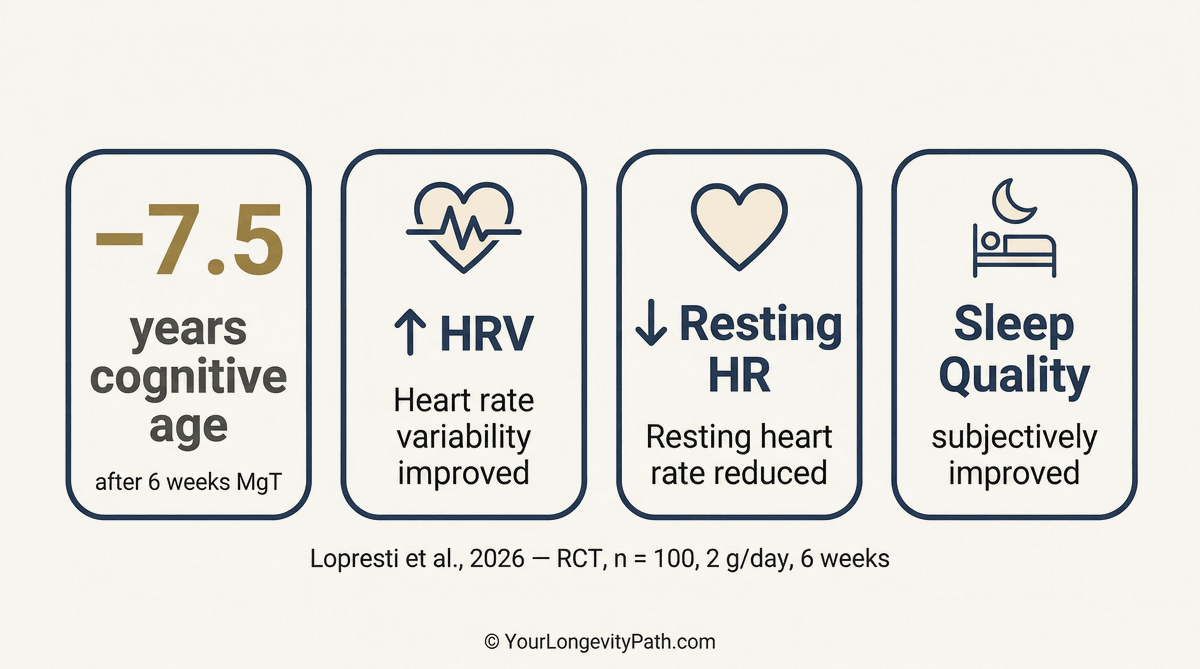 Fig. 2: Key results from the Lopresti RCT (2026): Cognitive rejuvenation of 7.5 years, improved heart rate variability, reduced resting heart rate, and improved subjective sleep quality after 6 weeks of 2 g magnesium L-threonate per day (Lopresti et al., 2026). © YourLongevityPath.com
Fear Extinction and Emotional Resilience
A landmark study by Abumaria et al. (2011) examined how magnesium L-threonate affects fear conditioning and extinction in the brain. Using rodent models, they found that elevated brain magnesium enhanced the extinction of fear memories, essentially the brain’s ability to “unlearn” threat associations.
This occurred specifically in the prefrontal cortex, the region responsible for executive control and rational evaluation. The mechanism: magnesium enhanced NMDA signaling and BDNF (brain-derived neurotrophic factor) in the prefrontal cortex, strengthening its ability to override emotional reactivity from the amygdala.
For humans under chronic stress, this translates to improved emotional regulation and faster recovery from acute stressors.
The Stress-Magnesium Vicious Cycle
Research by Pickering et al. (2020) summarizes a bidirectional relationship: stress depletes magnesium, and magnesium deficiency amplifies the stress response. In one analysis, supplementing 250mg per day of magnesium reduced serum cortisol in stressed individuals.
L-threonate is particularly suited to breaking this cycle because it reaches the brain directly, modulating ACTH release and adrenocortical sensitivity at the source.
Brain Protection Against Inflammation and Aging
Patel et al. (2024) demonstrated that chronic deficiency promotes neuroinflammation, an upstream driver of cognitive decline, neurodegeneration, and accelerated brain aging. By maintaining optimal cerebral levels, you suppress this inflammatory cascade. The mineral’s role as a natural NMDA antagonist prevents excitotoxicity, a process implicated in Alzheimer’s disease, Parkinson’s disease, and stroke recovery.
The evidence is consistent: elevated brain magnesium improves stress resilience, sleep, emotional regulation, and neuroprotection.
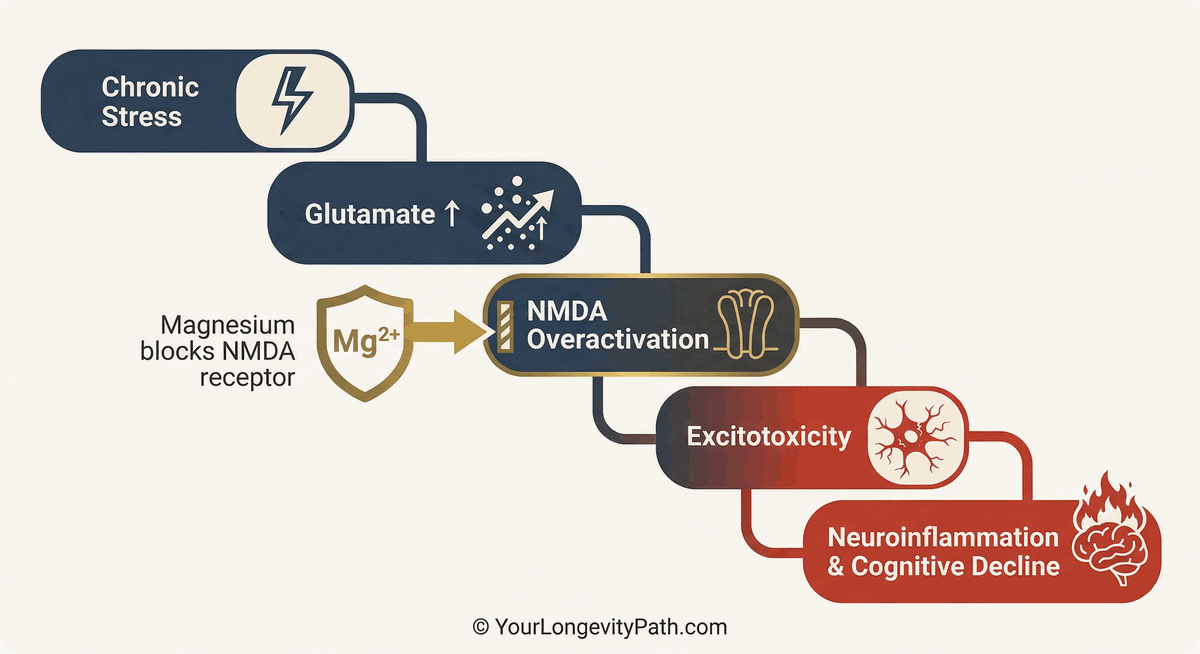 Fig. 3: The excitotoxicity cascade: Chronic stress triggers a chain reaction from glutamate overload through NMDA overactivation to neuronal damage and neuroinflammation. Magnesium blocks this cascade at step 3 as a natural NMDA antagonist (Patel et al., 2024; Sartori et al., 2012). © YourLongevityPath.com
Magnesium, Cortisol, and Cellular Aging
Here’s where longevity converges. Chronic stress and elevated cortisol trigger telomere shortening and adverse epigenetic changes, the hallmarks of accelerated cellular aging as outlined in foundational longevity research. Magnesium L-threonate addresses this upstream:
- Lowers cortisol via HPA axis regulation
- Improves sleep experience (a critical cortisol reset mechanism)
- Enhances HRV (a marker of biological age)
- Reduces neuroinflammation (a driver of systemic aging)
Add to that the cognitive rejuvenation: an estimated 7.5-year reduction in cognitive age after just 6 weeks of supplementation is a longevity result rarely seen. The result: better stress resilience, better sleep, and slower biological aging.
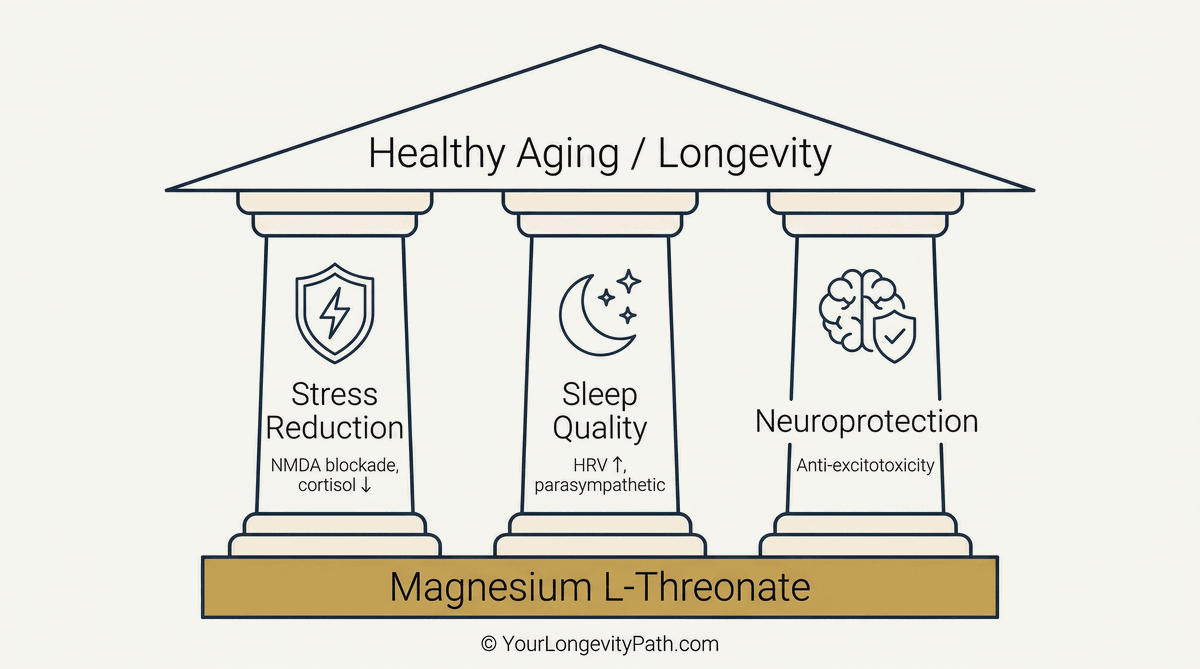 Fig. 4: The longevity triad: Magnesium L-threonate addresses three central pillars of healthy aging simultaneously. The interplay of stress reduction, improved sleep quality, and neuroprotection makes it a versatile longevity tool. © YourLongevityPath.com
Practical Considerations
Dosing and Elemental Magnesium
A typical dose of magnesium L-threonate is 2,000 mg daily (1,000 mg twice daily), taken with meals. This is the dose used in the Lopresti et al. (2026) trial, which showed benefits within 6 weeks. Important: 2,000 mg of magnesium L-threonate yields only about 144 mg of elemental magnesium. It is designed as a brain-specific add-on, not a replacement for your foundational magnesium supplement (such as magnesium bisglycinate for muscles and bones).
Starting Slowly
Unlike standard magnesium forms that cause digestive issues at high doses, magnesium L-threonate can cause mild headaches in the first few days of use, likely due to increased neuronal activity and neuroplasticity. Start with 1,000 mg in the evening to allow your brain to adjust, then increase to the full dose after a few days.
Timeline
Common effects include improved sleep quality and mental clarity within 2 to 3 weeks. Some people report reduced afternoon anxiety and improved emotional flexibility. Cognitive and neuroprotective effects develop over longer periods. The Lopresti trial showed significant cognitive improvements at 6 weeks.
Safety and Compatibility
Magnesium L-threonate (Magtein®) is safe and well-tolerated. Unlike some magnesium forms, it does not have a laxative effect (a common complaint with magnesium citrate or oxide). If you’re on medications affecting magnesium absorption (certain antibiotics, bisphosphonates, or diuretics), discuss timing with your healthcare provider.
It pairs well with other longevity foundations: consistent sleep, stress management practices, resistance training, and a whole-food diet. Think of it as insurance for your nervous system, supporting the neuroplasticity and stress resilience that make everything else work better.
A Note on Individual Variation
Brain magnesium status varies based on diet, stress history, genetics, and gut health. Some people notice dramatic shifts in stress resilience and sleep within weeks; others experience subtle improvements over 8 to 12 weeks. The science is clear: the mechanism works. Your timeline depends on your starting point.
If you’re serious about protecting your cognitive health and building true stress resilience, upgrading your magnesium might be the most effective biochemical switch you can flip. Not a trendy hack. Not a shortcut. A well-researched, mechanistically sound intervention that targets the brain where other supplements simply cannot reach.
If you’d like to explore related topics, read my article on why changing one habit at a time beats overhauling everything at once, or learn how breathing techniques influence cellular aging and stress resilience.
Whether magnesium is the right lever for you depends on your values and your daily life. My longevity coaching goes into that, and a free initial consultation is the easiest way to start.
Scientific Sources
Abumaria, N., Yin, B., Zhang, L., Li, X. Y., Chen, T., Descalzi, G., … & Zhuo, M. (2011). Effects of elevation of brain magnesium on fear conditioning, fear extinction, and synaptic plasticity in the infralimbic prefrontal cortex and lateral amygdala. Journal of Neuroscience, 31(42), 14871-14881. doi: 10.1523/JNEUROSCI.3782-11.2011
Lopresti AL, Smith SJ. The effects of magnesium L-threonate (Magtein®) on cognitive performance and sleep quality in adults: a randomised, double-blind, placebo-controlled trial. Frontiers in Nutrition. 2025;12:1729164. doi:10.3389/fnut.2025.1729164 · PMC12832366
Pickering, G., Mazur, A., Trousselard, M., Belin, A., Woodland, P., & Deville, G. (2020). Magnesium status and stress: The vicious circle concept revisited. Nutrients, 12(12), 3672. doi: 10.3390/nu12123672
Sartori, S. B., Whittle, N., Hetzenauer, A., & Singewald, N. (2012). Magnesium deficiency induces anxiety and HPA axis dysregulation: modulation by therapeutic drug treatment. Neuropharmacology, 62(1), 304-312. doi: 10.1016/j.neuropharm.2011.07.027
Slutsky, I., Abumaria, N., Wu, L. J., Huang, C., Zhang, L., Li, B., … & Zhuo, M. (2010). Enhancement of learning and memory by elevating brain magnesium. Neuron, 65(2), 165-177. doi: 10.1016/j.neuron.2009.12.026
Sun, Q., Weinger, J. G., Mao, F., & Liu, G. (2016). Regulation of structural and functional synapse density by L-threonate through modulation of intraneuronal magnesium concentration. Neuropharmacology, 108, 426-439. doi: 10.1016/j.neuropharm.2016.05.006
Patel, V., Akimbekov, N. S., Grant, W. B., Dean, C., Fang, X., & Razzaque, M. S. (2024). Neuroprotective effects of magnesium: implications for neuroinflammation and cognitive decline. Frontiers in Endocrinology, 15, 1406455. doi: 10.3389/fendo.2024.1406455
Does magnesium L-threonate really make you cognitively younger?
A randomised trial showed a cognitive age reduction of 7.5 years after 6 weeks. It measured episodic memory and executive function — not subjective feeling.
Can I take magnesium L-threonate with other magnesium forms?
Yes. Magnesium L-threonate works primarily in the brain. For muscles and sleep, magnesium glycinate can complement it well — the forms serve different functions.
How does magnesium L-threonate help with chronic stress?
It blocks overactive NMDA receptors and downregulates the HPA axis, breaking the vicious cycle of stress, magnesium depletion, and even more stress.
This article is for informational purposes only and does not replace professional medical advice, diagnosis, or treatment. If you have health concerns, please consult a qualified healthcare professional.