Lifestyle
Habit Change Science: Why One Habit Beats Three (80% vs 5%)
7 March 2026 · By Dr. B.J. Huber · 6 min read
You Know Enough. You’re Just Not Doing It.
Maybe this sounds familiar: you’ve spent weeks reading up on health. Podcasts, Facebook groups, Instagram accounts. You know that nutrition matters, that you should strength train, that your sleep could be better, that stress is a problem. You want to change things. Ideally everything. Ideally right now.
And that’s exactly where it goes wrong. Not because you don’t know enough. Because you want too much at once.
- One habit at a time achieves 80% long-term success; two simultaneous habits drops to 35%; three or more collapses below 5% — the prefrontal cortex has finite cognitive bandwidth (Precision Nutrition, n>100,000).
- Chronic perfectionism and the stress of attempting simultaneous overhauls shortens telomeres by the equivalent of 10 years of biological aging through elevated cortisol (Epel & Blackburn, 2004).
- New habits become automatic after an average of 66 days via tiny incremental changes anchored to existing routines — the only sustainable path that avoids the ego-depletion crash.
The Numbers Are Clear
Data from Precision Nutrition, based on over 100,000 clients, shows a stark pattern: when people focus on a single habit change, the long-term success rate is above 80 percent. Two habits at once? Below 35 percent. Three or more? Below 5 percent.
The explanation lies in the prefrontal cortex, the part of your brain responsible for conscious decision-making. Every new habit requires cognitive bandwidth. Overload the system, and it shuts down. Baumeister et al. (1998) called this ego depletion: self-regulation is a limited resource.
More recent psychological research (like the Opportunity Cost Model by Inzlicht or Kurzban) adds a fascinating nuance to this picture: it’s less about a metaphorical willpower tank running on empty. Rather, your brain actively computes that the cognitive costs of too many simultaneous changes are simply too high — and drastically shifts its motivation away from what you “have” to do, toward what you “want” to do. Trying to overhaul everything at once essentially provokes a biological strike by your nervous system.
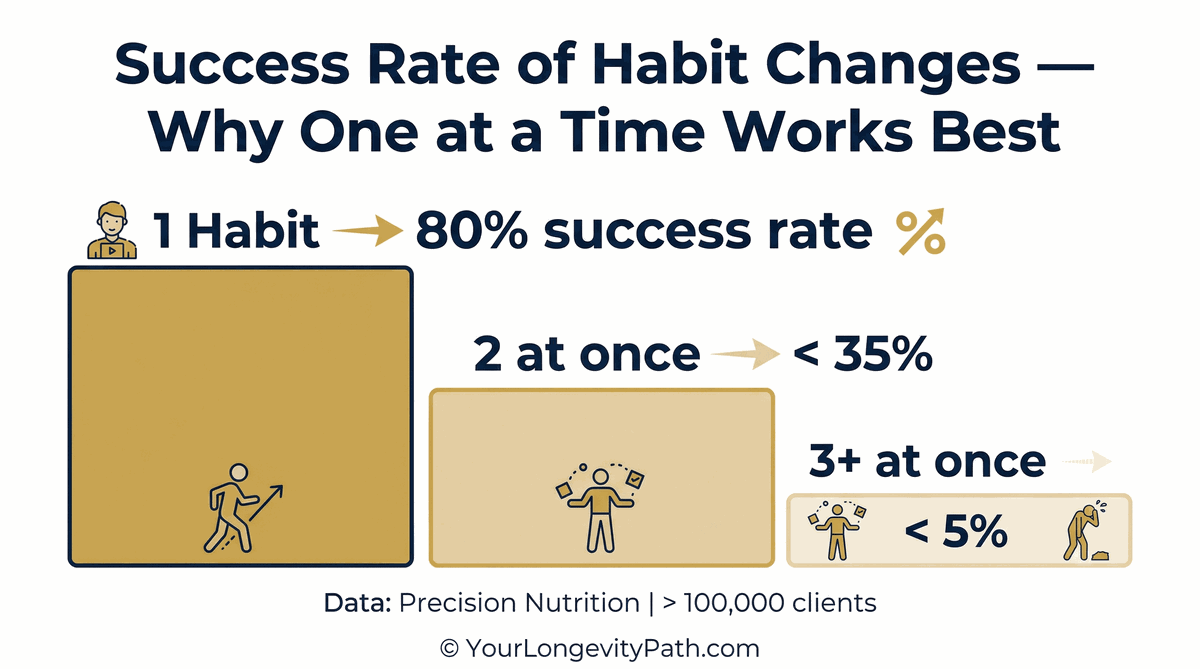 Fig. 1: Focusing on one habit at a time yields an 80% success rate — three or more at once drops below 5% (Data: Precision Nutrition, >100,000 clients).
The Stress of Trying to Be Healthy Is Making You Sick
Here’s the paradox: the pressure to do everything right creates exactly the kind of stress that accelerates cellular aging. Your body can’t tell the difference between work stress and the stress of sticking to the perfect nutrition plan. This is one of the clearest connections between stress and the actual biological mechanisms of aging.
Epel and Blackburn showed in 2004 that chronically elevated perceived stress shortens telomeres by the equivalent of ten years of aging. Telomeres are the protective caps on your chromosomes: the shorter they get, the faster your cells age. At the same time, chronic stress suppresses telomerase, the enzyme that repairs telomeres.
Zannas et al. (2015) also showed that cumulative lifetime stress accelerates epigenetic aging, the biological clock driven by DNA methylation patterns. Chronically elevated cortisol alters the methylation of genes that regulate the stress response, including the glucocorticoid receptor (NR3C1). In other words: your body gets progressively worse at handling stress.
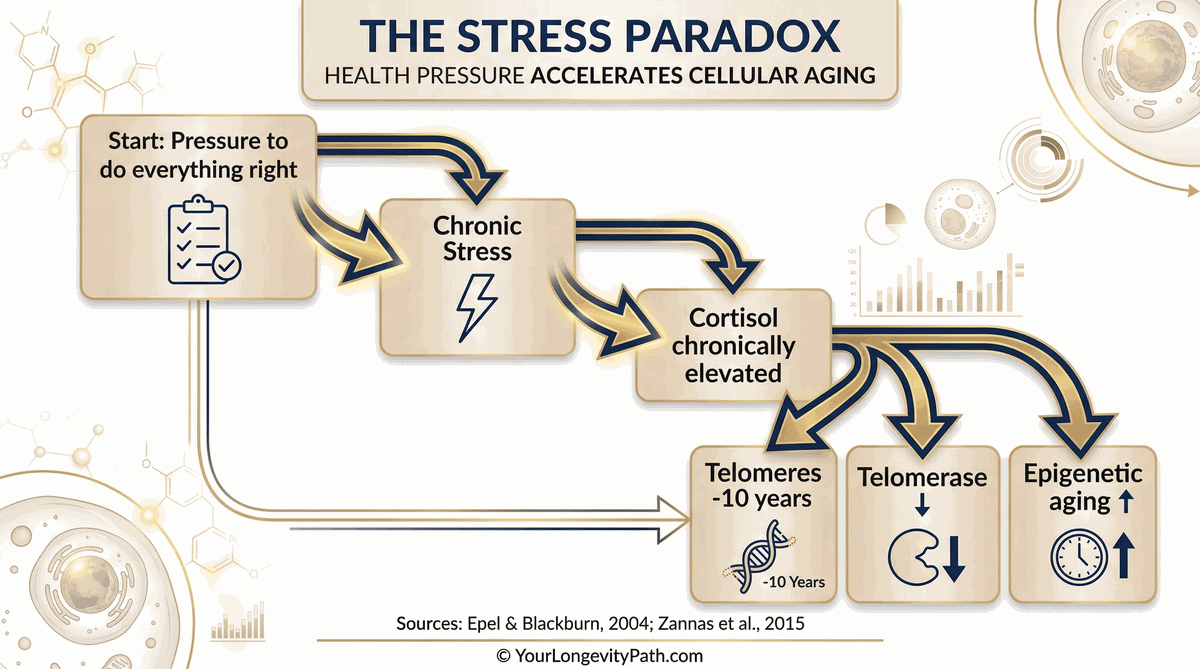 Fig. 2: The pressure to do everything right shortens telomeres by the equivalent of ten years of aging and accelerates epigenetic aging (Epel & Blackburn, 2004; Zannas et al., 2015).
The Solution: One Change at a Time
Research on habit formation points to a clear path forward. Lally et al. (2010) found that it takes an average of 66 days for a new habit to become automatic. That doesn’t mean you have to wait 66 days before starting something new. But the first change should feel stable before you add the next.
Two strategies have proven especially effective:
Tiny Habits (BJ Fogg): Make the new habit so small you can’t fail. Not “meditate for 30 minutes,” but “after I get up, take three deep breaths.” Small early wins activate the brain’s reward system and make scaling much easier.
Habit Stacking (James Clear): Anchor new habits to existing routines. “After my morning coffee, I take my vitamin D.” The neural linkage makes the new habit stick more reliably.
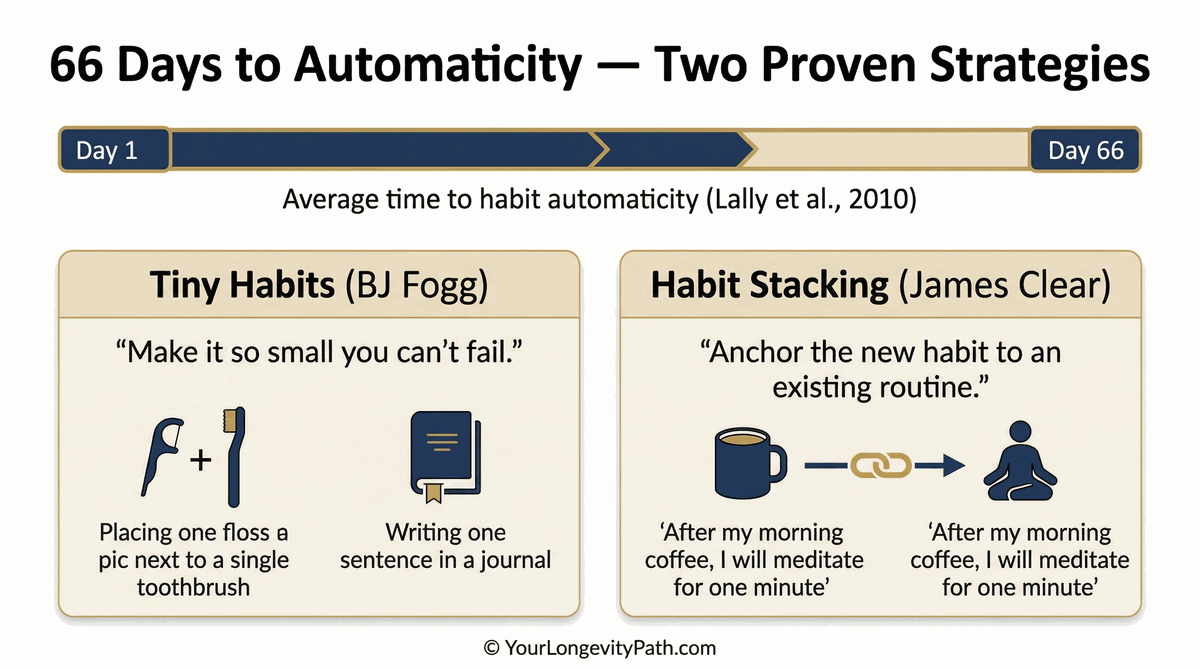 Fig. 3: On average, it takes 66 days for a new habit to become automatic — Tiny Habits (BJ Fogg) and Habit Stacking (James Clear) are the most effective strategies (Lally et al., 2010).
What This Means for You
Instead of changing ten things at once, choose one. Look at where you have the most room to grow. Maybe it’s sleep, maybe nutrition, maybe strength training. Implement one small change, track it with a simple checkmark, and give yourself four weeks. No perfectionism. No guilt.
When the change feels natural, add the next. One step at a time. The way your body and brain can actually process it.
If you want to understand the deeper foundations of longevity itself — the biological mechanisms that actually drive healthy aging — start with what longevity actually means. And for a more detailed plan for how to approach each of the eight core longevity dimensions (nutrition, movement, sleep, stress, hormones, social connection, substances, and prevention) step by step and without overwhelm, you’ll find my free guide with concrete 4-week plans for every area.
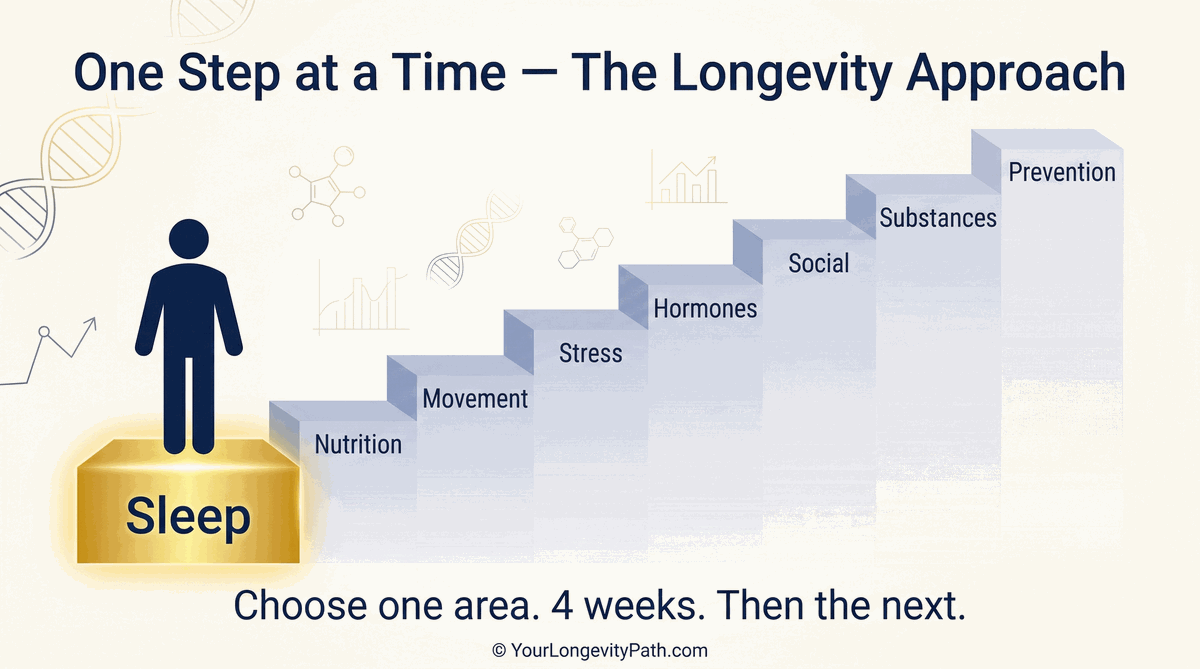 Fig. 4: The Longevity Approach — choose one area, give yourself 4 weeks, then move to the next. The way your body and brain can actually process it.
Which single habit should come first depends on where you are starting from. In my longevity coaching we set that order together, and a free initial consultation is the beginning of it.
Scientific Sources
Epel, E. S., Blackburn, E. H., Lin, J., et al. (2004). Accelerated telomere shortening in response to life stress. PNAS, 101(49), 17312-17315.
Zannas, A. S., et al. (2015). Lifetime stress accelerates epigenetic aging. Genome Biology, 16, 266.
Lally, P., et al. (2010). How are habits formed. European Journal of Social Psychology, 40(6), 998-1009.
Baumeister, R. F., et al. (1998). Ego depletion. Journal of Personality and Social Psychology, 74(5), 1252-1265.
Inzlicht, M., Schmeichel, B. J., & Macrae, C. N. (2014). Why self-control seems (but may not be) limited. Trends in Cognitive Sciences, 18(3), 127-133.
Why do most health resolutions fail?
The prefrontal cortex has limited capacity. Changing three habits simultaneously has under 5% success rate — focusing on one habit achieves 80%.
How long does it take to form a new habit?
On average 66 days, not 21 as commonly claimed. The key is automaticity: when the action no longer requires a conscious decision, the habit has formed.
Is perfectionism harmful to health goals?
Yes, measurably so. Chronic perfectionism stress shortens telomeres by the equivalent of up to 10 life years. Small, consistent steps work better than radical overhauls.
This article is for informational purposes only and does not replace professional medical advice, diagnosis, or treatment. If you have health concerns, please consult a qualified healthcare professional.