Stress
15 Minutes in the Forest — and Your Nervous System Shifts
22 April 2026 · By Dr. B.J. Huber · 16 min read
Monday, 8:15 AM. Your inbox is overflowing, your calendar is packed, and your mind has been racing since you woke up. You notice it in the shallow breathing, the tension in your jaw, the feeling of never truly being able to switch off. Your sympathetic nervous system is running at full throttle — and you’re not alone.
What if the most effective countermeasure isn’t found in a pharmacy, but growing right outside your door?
Research over the past 15 years shows with remarkable consistency: spending time in forests lowers stress hormones, shifts the autonomic nervous system toward parasympathetic dominance, and produces effects that reach all the way to your immune cells. This isn’t wellness marketing. This is physiology. And for people who are chronically stressed, whose nervous system is permanently stuck in alarm mode, or who are neurodivergent and struggling with sensory overload, the forest may be one of the most underestimated tools available.
- Forest walks lower cortisol by 12.4%, reduce heart rate by 5.8%, and activate the parasympathetic nervous system — measurable effects that appear within a single visit.15
- Phytoncides (tree-released volatile compounds) increase natural killer cell activity by up to 50% for 7+ days, directly counteracting the immune aging (immunosenescence) that drives cancer and infection risk.10
- Ninety minutes in nature measurably quiets the brain’s rumination center (subgenual prefrontal cortex) and triggers “soft fascination” — the same cognitive restoration that meditative practices produce.5
What happens when your nervous system won’t downregulate?
Chronic stress locks the autonomic nervous system into sympathetic dominance. Cortisol stays elevated, heart rate variability drops, inflammatory markers rise, and sleep deteriorates — a state that accelerates cellular aging over time and is particularly pronounced in neurodivergent individuals.
Most people who come to my coaching practice describe a similar pattern: chronic exhaustion, yet simultaneously feeling wired. The body is exhausted, but the nervous system is wired. This isn’t a contradiction — it’s the result of chronic sympathetic dominance. Like controlled breathing practices, forest exposure offers a powerful tool for shifting this imbalance.
Your autonomic nervous system consists of two counterparts: the sympathetic system (activation, fight-or-flight) and the parasympathetic system (recovery, regeneration). Ideally, they alternate. Under chronic stress, the balance tips: the sympathetic system dominates permanently, and the parasympathetic system can’t adequately kick in.
The consequences are biochemically measurable: elevated cortisol, elevated inflammatory markers, reduced heart rate variability, disrupted sleep, and in the long term, accelerated cellular aging.21 For neurodivergent individuals, particularly those with ADHD, there’s an additional dimension: the nervous system is inherently more vulnerable to dysregulation, and the ability to flexibly switch between arousal and calm is often impaired.4
In his Polyvagal Theory, Stephen Porges describes a process that explains why some environments instantly calm us while others keep us on edge: neuroception.18 Unlike conscious perception, neuroception continuously and unconsciously scans the environment for signals of safety or danger. Urban stimuli (noise, crowds, rapid movements) chronically activate threat detection. The forest, on the other hand, sends exactly the signals our nervous system is evolutionarily calibrated for: steady sounds, slow movements, absence of social threat. It communicates safety to the body at a level below conscious awareness, and that’s precisely what allows the parasympathetic system to regain control.
For people with ADHD, this is particularly relevant: their nervous system often reacts more sensitively to urban threat cues, leading to a state of chronic hypervigilance. The forest offers a sensory environment that calms neuroception rather than further triggering it.
This is exactly where the forest comes in.
How does a forest walk affect cortisol, blood pressure, and HRV?
A single forest walk lowers cortisol by 12.4%, pulse rate by 5.8%, and systolic blood pressure by 1.4%. Parasympathetic activity increases measurably at the same time — confirmed in a crossover study with 280 participants across 24 different forests in Japan.
The largest and most methodologically robust study on Shinrin-yoku (Japanese for “forest bathing”) comes from Park and colleagues (2010). In a field study with 280 participants across 24 different forests in Japan, the physiological effects of a forest walk were compared with those of an urban walk — in a crossover design, meaning the same individuals experienced both conditions.
The results were clear: cortisol dropped by 12.4%, pulse rate by 5.8%, systolic blood pressure by 1.4%. These are remarkably similar to the cortisol reductions measured with slow breathing practices. Simultaneously, the HF component of heart rate variability (a measure of parasympathetic activity) increased significantly, while the LF/HF ratio (a measure of sympathetic dominance) decreased.
This means: the forest measurably shifts your autonomic nervous system toward recovery. Not eventually. Not after weeks. Within a single visit.
A meta-analysis by Antonelli and colleagues (2019), published in the International Journal of Biometeorology, confirmed this finding across 22 studies: in virtually all studies examined, cortisol levels were significantly lower in the forest group compared to the urban group.
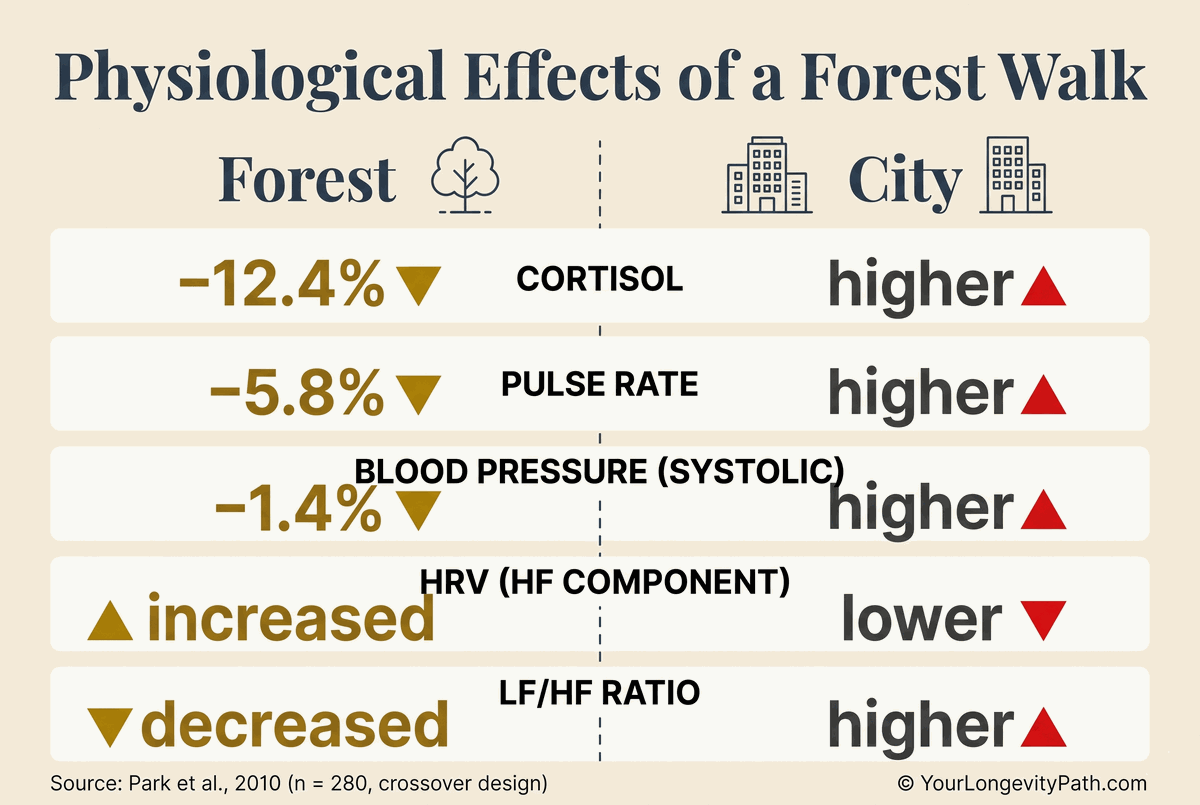 Fig. 1: Physiological effects of a forest walk compared to an urban environment. Cortisol, pulse rate, and blood pressure decrease, while parasympathetic activity (HF-HRV) increases.15 © YourLongevityPath.com
What are phytoncides and how do they boost your immune system?
Phytoncides are volatile organic compounds released by trees to defend against insects and microbes. When inhaled, they activate natural killer cells by up to 50%, increase the expression of cytotoxic proteins, and directly counteract immunosenescence — the age-related decline of immune function.
Trees communicate. Not with words, but with molecules. Phytoncides are volatile organic compounds released by trees into the air, including alpha-pinene, limonene, and camphor. They serve as the trees’ defense against insects and microbes. But they also act on your immune system.
The pioneering work comes from Qing Li, one of the founders of forest medicine at Nippon Medical School in Tokyo. Li and colleagues (2006, 2008, 2010) conducted a series of studies showing that a three-day forest stay increases natural killer (NK) cell activity by up to 50%, and this effect persists for at least 7 days. After 30 days, NK cells were still significantly more active than before the forest visit.
The mechanism is remarkable: phytoncides increase the expression of perforin, granzyme A, and granulysin in NK cells — the cytotoxic proteins that NK cells use to kill virus-infected or malignant cells. This was confirmed in a recent meta-analysis:1 phytoncide exposure led to a significant increase in NK cell activation (effect size: 2.50; 95% CI [1.94–3.05]).
What makes this particularly compelling: in control experiments where participants took a city trip instead of a forest trip, the NK cell effect did not occur. And when Li administered isolated phytoncides via a vaporizer in a hotel room, the effect still appeared.13 This demonstrates that it’s the volatile plant compounds specifically — not just the relaxation or the physical activity — that activate the immune system.
Why does this matter for longevity? NK cells are a central component of innate immunity and play a key role in eliminating tumor cells and controlling chronic viral infections. Declining NK cell function is a hallmark of the aging immune system (immunosenescence) and is considered one of the reasons why cancer risk and susceptibility to infections increase with age.
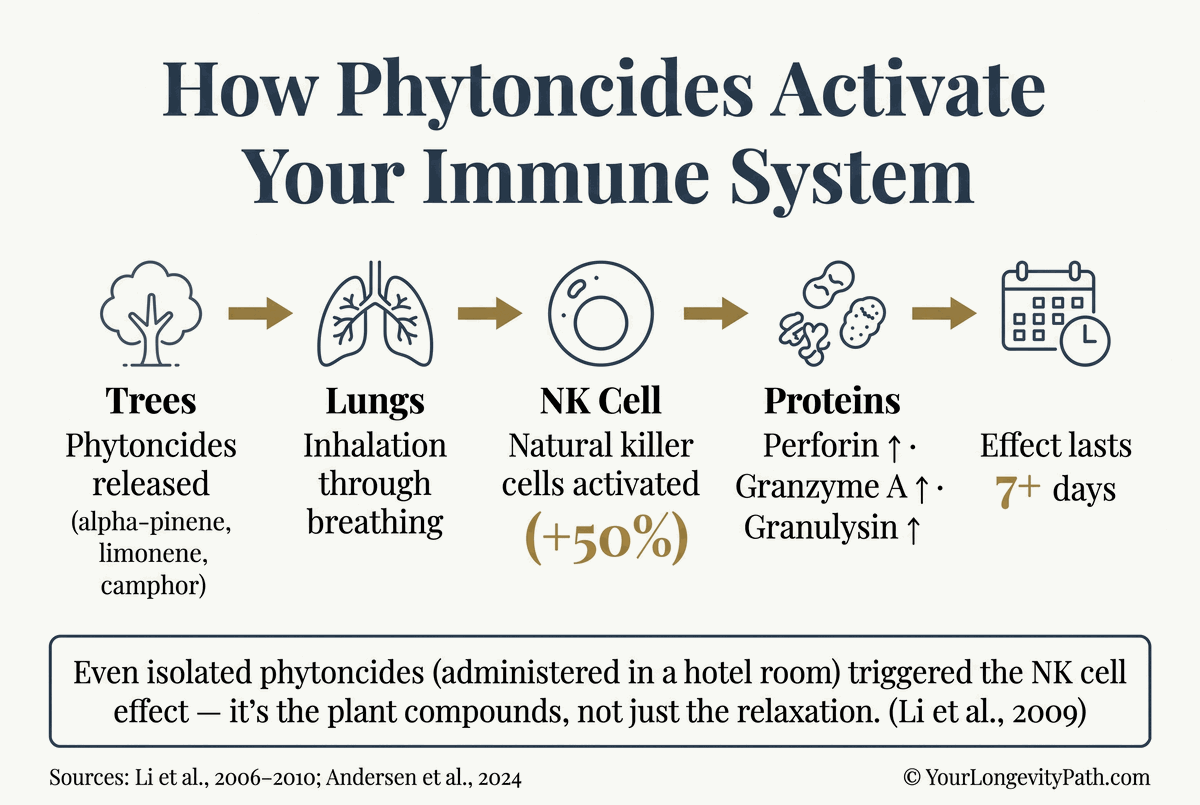 Fig. 2: How phytoncides from the forest activate natural killer cells: the volatile plant compounds increase the expression of cytotoxic proteins — an effect that persists for at least 7 days after the forest visit.1,10 © YourLongevityPath.com
Why does the forest reduce rumination and improve focus?
Ninety minutes in nature reduces activity in the subgenual prefrontal cortex — the brain region responsible for rumination. At the same time, the “soft fascination” of natural environments enables recovery of directed attention, comparable to the cognitive effects of light meditation.
For people who are chronically stressed or neurodivergent, one of the biggest challenges is the thought spiral. The rumination that won’t stop. The mind that won’t quiet down, even at night. In neuroscience, this phenomenon has a name: rumination — and it’s closely linked to activity in the Default Mode Network (DMN) and specifically the subgenual prefrontal cortex.
Bratman and colleagues (2015) published an elegant study in the Proceedings of the National Academy of Sciences (PNAS): participants who walked for 90 minutes in a natural environment showed significantly less rumination and reduced neural activity in the subgenual prefrontal cortex compared to participants who spent the same time walking along a busy road.
This isn’t just a “nice feeling.” This is a measurable change in brain activity in a region that is overactive in depression, anxiety disorders, and chronic stress.
For neurodivergent individuals, an additional mechanism comes into play: Attention Restoration Theory (ART) by Kaplan (1995). The theory proposes that natural environments enable a special type of attention called “soft fascination.” In the forest, there are enough sensory stimuli (rustling leaves, play of light, birdsong) to gently engage the brain, but not enough to overwhelm it. This allows directed attention, which is constantly demanded in daily life, to recover.
Why does this work so reliably? The answer lies in geometry. Trees, branches, ferns, and clouds grow in so-called fractal patterns: self-repeating structures that look similar at every scale. The human visual system has adapted to precisely these patterns over millions of years. Hagerhall, Taylor, and colleagues (2008) showed in an EEG study that viewing fractal patterns with a fractal dimension around 1.3 (which corresponds exactly to the range of natural landscapes) triggers increased alpha waves in the frontal lobes. Alpha waves (8–12 Hz) are the signature of a state of wakeful relaxation, comparable to light meditation. In follow-up studies using skin conductance measurements, Taylor’s group demonstrated that viewing natural fractals reduces the physiological stress response by up to 60%.20 For comparison: urban architecture consists primarily of Euclidean geometry (hard edges, right angles), which costs the brain significantly more processing effort.
For people with ADHD, this is particularly relevant. Faber Taylor and Kuo (2011) showed in a randomized study that a 20-minute walk in a park significantly improved concentration in children with ADHD, comparable to the effect of methylphenidate. Kuo and Faber Taylor (2004) found in a large parent survey that activities in green settings consistently reduced ADHD symptoms (inattention and impulsivity) more than activities indoors or in urban environments.
A systematic review3 confirmed that nature exposure is consistently associated with reduced ADHD diagnoses and lower symptom severity, though the authors noted the need for more methodologically rigorous studies.
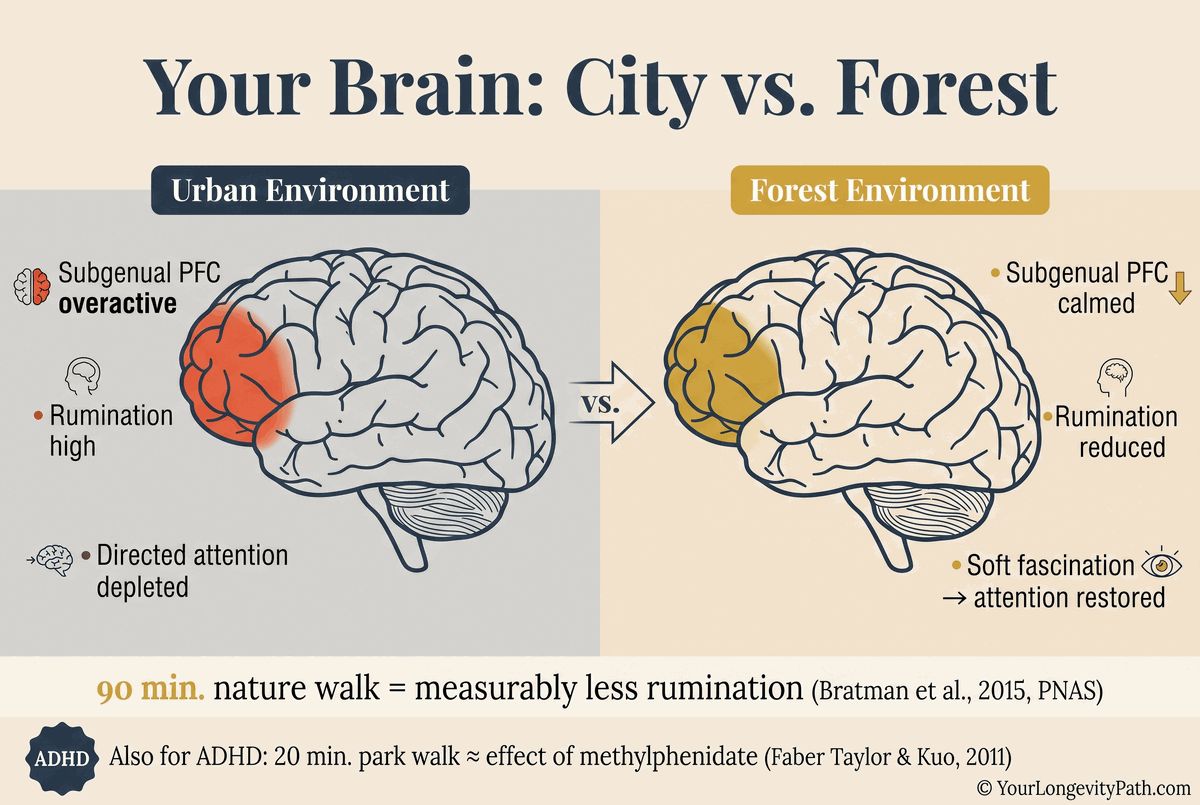 Fig. 3: How the forest changes the brain: A 90-minute nature walk reduces activity in the subgenual prefrontal cortex (associated with rumination) and enables cognitive recovery through “soft fascination”.5,8 © YourLongevityPath.com
Which Hallmarks of Aging does the forest address?
Regular forest exposure acts on four central mechanisms of biological aging: it dampens chronic inflammation (inflammaging), strengthens immune function against immunosenescence, reduces cellular oxidative stress, and potentially slows telomere shortening through sustained cortisol reduction and parasympathetic activation.
The effects of the forest touch several of the so-called Hallmarks of Aging — the biological hallmarks of the aging process:
Chronic inflammation (Inflammaging): Cortisol reduction and parasympathetic activation dampen the systemic inflammatory response. Forest visits have been shown to lower inflammatory markers such as TNF-alpha and IL-6.12
Immunosenescence: The boost in NK cell activity through phytoncides directly counteracts the age-related decline in immune function.
Cellular stress: Reduced cortisol means less oxidative stress and less damage to DNA, proteins, and lipids.
Telomere shortening: Chronic stress is one of the strongest accelerators of telomere shortening.6 Any intervention that sustainably lowers cortisol and strengthens the parasympathetic system has the potential to slow this process.
This means: regular forest visits aren’t just a short-term stress intervention. They address the biological mechanisms that determine the speed of your aging over decades.
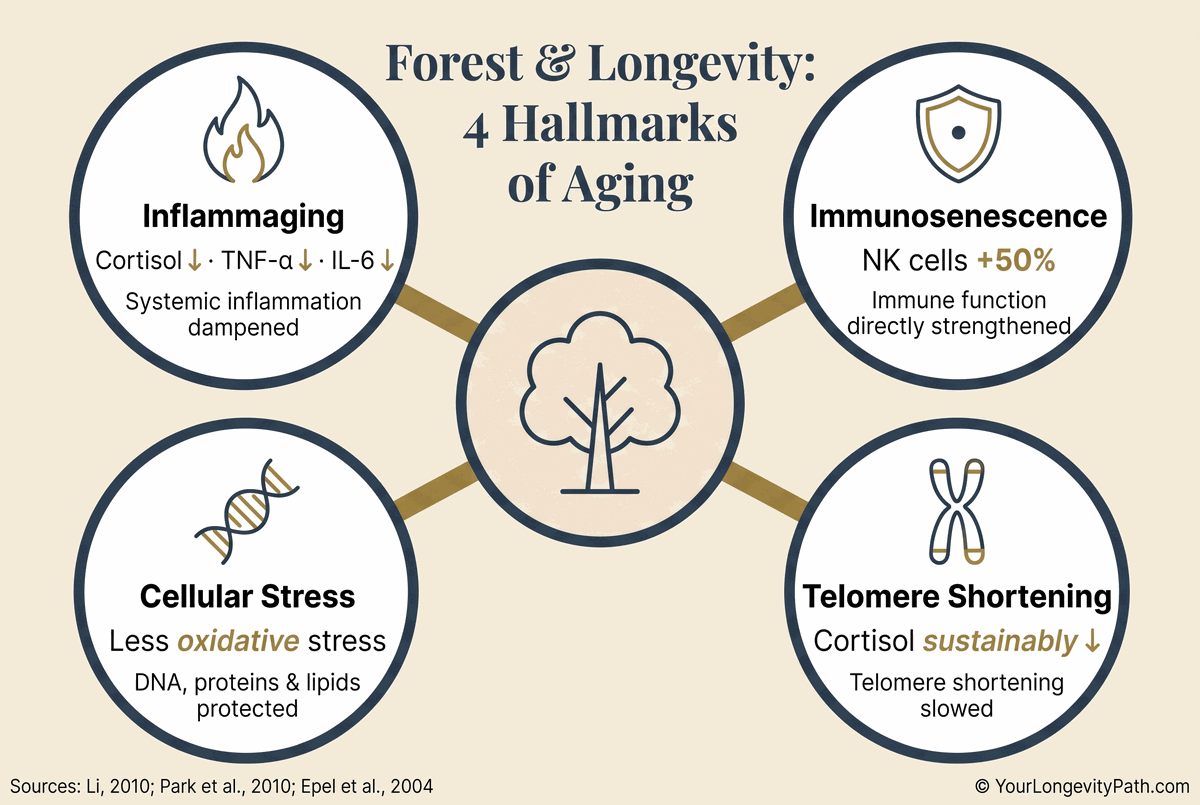 Fig. 4: How regular forest visits address four central Hallmarks of Aging: inflammaging, immunosenescence, cellular stress, and telomere shortening.6,10,15 © YourLongevityPath.com
How do you use the forest optimally for your health?
As little as 15–20 minutes in the forest produces measurable effects on cortisol and heart rate variability. For maximum immune impact, 2–3 hours are ideal. The key factors are consistency, conscious nasal breathing, and sensory immersion without screens — ideally in coniferous forests.
Research shows that even brief forest visits produce measurable effects. You don’t need a three-day retreat in the Black Forest. Here are the key factors:
- Duration: As little as 15–20 minutes in the forest shows physiological effects on HRV and cortisol. For maximum impact on NK cells and immune function, 2–3 hours are ideal.10
- Frequency: Consistency beats intensity. Two to three short forest walks per week are more effective than a rare full-day outing.
- Mindfulness: Walk slowly, breathe consciously, open your senses. This isn’t hiking with a performance mindset, it’s sensory immersion. Smell the earth (more on that in a moment), hear the birds, feel the air on your skin.
- Consciously smell the soil: The typical scent of the forest floor has a biochemical backstory. Moist forest soil harbors the harmless bacterium Mycobacterium vaccae. Lowry and colleagues (2007) showed that contact with this bacterium activates serotonergic neurons in the dorsal raphe nucleus and increases serotonin levels in the prefrontal cortex. In mouse models, M. vaccae acted similarly to a mild antidepressant and reduced anxiety-like behavior.17,19 So when you breathe deeply in the forest and take in the smell of damp earth, it’s not esoteric “grounding,” it’s contact with microorganisms that demonstrably influence serotonin signaling.
- Nasal breathing: Phytoncides are absorbed through the airways. Conscious nasal breathing maximizes the uptake of volatile plant compounds.
- Screen-free: Leave your phone in your pocket. The cognitive recovery effect (Attention Restoration) only works when you actually unload directed attention.
- Seek out coniferous trees: Conifers (like spruce, pine, and fir) release particularly high amounts of phytoncides, especially alpha-pinene. A coniferous forest is biochemically more potent than a purely deciduous one.
For neurodivergent individuals, the forest can be an especially valuable resource: the sensory environment is rich but not overwhelming. There are no social demands, no performance pressure, no screens. The nervous system gets exactly what it needs: stimulation without overload.
Conclusion
If your nervous system is permanently stuck in alarm mode, if you can’t switch off in the evening, if your mind is constantly racing — then the forest isn’t a nice leisure activity. It’s one of the few interventions that simultaneously lowers cortisol, activates the parasympathetic system, boosts the immune system, and allows the brain to exit rumination mode. All without side effects, without a prescription, and without a waiting list.
The research is clear. The trees are ready. The only question is whether you’ll go.
If you want to find out what genuinely takes the load off your nervous system, my longevity coaching provides the framework, and a free initial consultation is the easiest way in.
Scientific Sources
- Lew T, Fleming KJ. Phytoncides and immunity from forest to facility: A systematic review and meta-analysis. Pharmacol Res Nat Prod. 2024;4:100061.
- Antonelli, M. et al. (2019). Effects of forest bathing (shinrin-yoku) on levels of cortisol as a stress biomarker: a systematic review and meta-analysis. International Journal of Biometeorology, 63(8), 1117–1134. doi: 10.1007/s00484-019-01717-x
- Hood M, Baumann O. Could Nature Contribute to the Management of ADHD in Children? A Systematic Review. Int J Environ Res Public Health. 2024;21(6):736. doi:10.3390/ijerph21060736
- Beauchaine, T.P. & Thayer, J.F. (2015). Heart rate variability as a transdiagnostic biomarker of psychopathology. International Journal of Psychophysiology, 98(2), 338–350.
- Bratman, G.N. et al. (2015). Nature experience reduces rumination and subgenual prefrontal cortex activation. Proceedings of the National Academy of Sciences, 112(28), 8567–8572. doi: 10.1073/pnas.1510459112
- Epel, E.S. et al. (2004). Accelerated telomere shortening in response to life stress. Proceedings of the National Academy of Sciences, 101(49), 17312–17315.
- Faber Taylor, A. & Kuo, F.E. (2011). Could Exposure to Everyday Green Spaces Help Treat ADHD? Evidence from Children’s Play Settings. Applied Psychology: Health and Well-Being, 3(3), 281–303.
- Kaplan, S. (1995). The restorative benefits of nature: Toward an integrative framework. Journal of Environmental Psychology, 15(3), 169–182.
- Kuo, F.E. & Faber Taylor, A. (2004). A potential natural treatment for attention-deficit/hyperactivity disorder: evidence from a national study. American Journal of Public Health, 94(9), 1580–1586.
- Li, Q. (2010). Effect of forest bathing trips on human immune function. Environmental Health and Preventive Medicine, 15(1), 9–17. doi: 10.1007/s12199-008-0068-3
- Li, Q. et al. (2006). Phytoncides (wood essential oils) induce human natural killer cell activity. Immunopharmacology and Immunotoxicology, 28(2), 319–333.
- Li, Q. et al. (2008). A forest bathing trip increases human natural killer activity and expression of anti-cancer proteins in females. Journal of Biological Regulators and Homeostatic Agents, 22(1), 45–55.
- Li, Q. et al. (2009). Effect of phytoncide from trees on human natural killer cell function. International Journal of Immunopathology and Pharmacology, 22(4), 951–959.
- Li, Q. et al. (2011). Acute effects of walking in forest environments on cardiovascular and metabolic parameters. European Journal of Applied Physiology, 111(11), 2845–2853.
- Park, B.J. et al. (2010). The physiological effects of Shinrin-yoku (taking in the forest atmosphere or forest bathing): evidence from field experiments in 24 forests across Japan. Environmental Health and Preventive Medicine, 15(1), 18–26. doi: 10.1007/s12199-009-0086-9
- Hagerhall, C.M. et al. (2008). Investigations of human EEG response to viewing fractal patterns. Perception, 37(10), 1488–1494. doi: 10.1068/p5918
- Lowry, C.A. et al. (2007). Identification of an immune-responsive mesolimbocortical serotonergic system: Potential role in regulation of emotional behavior. Neuroscience, 146(2), 756–772. doi: 10.1016/j.neuroscience.2007.01.067
- Porges, S.W. (2004). Neuroception: A subconscious system for detecting threats and safety. Zero to Three, 24(5), 19–24.
- Reber, S.O. et al. (2016). Immunization with a heat-killed preparation of the environmental bacterium Mycobacterium vaccae promotes stress resilience in mice. Proceedings of the National Academy of Sciences, 113(22), E3130–E3139. doi: 10.1073/pnas.1600324113
- Taylor, R.P. et al. (2011). Perceptual and physiological responses to Jackson Pollock’s fractals. Frontiers in Human Neuroscience, 5, 60. doi: 10.3389/fnhum.2011.00060
- Thayer, J.F. et al. (2012). A meta-analysis of heart rate variability and neuroimaging studies: Implications for heart rate variability as a marker of stress and health. Neuroscience & Biobehavioral Reviews, 36(2), 747–756.
How long do you need to spend in a forest to feel an effect?
Measurable heart rate variability changes appear after just 15 minutes. For immune effects on natural killer cells, studies recommend at least 90 minutes to 2 hours.
What are phytoncides and how do they work?
Phytoncides are volatile organic compounds trees release for defence. When inhaled, they boost natural killer cell activity by up to 50% — measurable for over 7 days.
Does forest bathing work for ADHD?
Yes. A study showed that 20 minutes of walking in a park improved concentration in ADHD children similarly to methylphenidate — via parasympathetic nervous system activation.
This article is for informational purposes only and does not replace professional medical advice, diagnosis, or treatment. If you have health concerns, please consult a qualified healthcare professional.